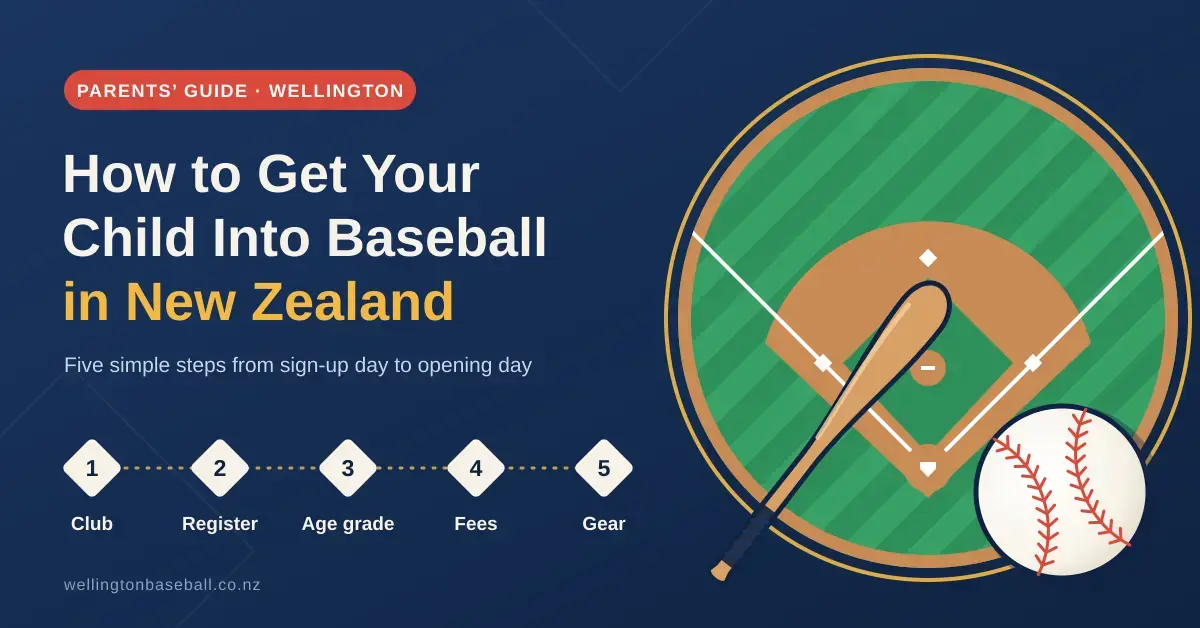
Signing your child up for baseball in New Zealand is more straightforward than many parents expect. In the Wellington region it usually comes down to a handful of steps: choose a local club, register through the national online system, place your child in the correct age grade, pay the season fees, and gather a small amount of personal gear before the summer season begins. This guide walks through each stage so you know what to expect between sign-up day and opening day.
Key Points
- Choose a club: find a local Wellington-region club such as the Wellington City Pirates or Hutt Valley Hornets.
- Register on GameDay: create an account and complete the current season’s form before Labour Weekend.
- Check the age grade: confirm your child’s grade (T-Ball, Minors, Majors or Junior/Senior) against the club’s age chart.
- Budget for fees: a club fee (roughly $75–$250) plus a modest standalone Baseball NZ national levy.
- Gather personal gear: a well-fitting glove, protective cup for boys, moulded cleats and white baseball pants.
Choosing a club in the Wellington region
The Wellington Baseball Association (WBA) is the regional body that organises club competition across greater Wellington. Its Travel League runs games throughout the region — from the Wairarapa and Levin down to Hutt City and Porirua — so where you play often depends on which suburb or valley you live in. Two of the best-known junior clubs are the Wellington City Pirates, based around central sportsgrounds, and the Hutt Valley Hornets, who serve families in Lower Hutt and the surrounding valley.
If you are still weighing up which club fits your family, our overview of Wellington baseball teams from Little League to senior grades is a good starting point, and parents new to the youth game may find our guide to Little League baseball in Wellington helpful.
Where the main clubs play
- Wellington City: central suburbs, served mainly by the Wellington City Pirates.
- Hutt Valley: the Hutt Valley Hornets cover Lower Hutt and the wider valley.
- Porirua, Levin and the Wairarapa: affiliated teams that also play in the WBA Travel League.
- Not sure where to start? Most clubs run their sign-up pages through the Sporty.co.nz platform, and the WBA can point you to the club nearest your home or school zone.
Registering through GameDay
Every junior player in New Zealand is registered through GameDay, the national online platform Baseball New Zealand uses to manage player details, payments and team information in one place. Creating a GameDay account (sometimes called a passport) links your child to both their local club and the national body, which is required before they can take part in any sanctioned league, tournament or trial.
Registration typically opens in August for the season ahead. Enter your child’s date of birth carefully, because age eligibility decides which grade they play in and is enforced for fairness and safety. It pays to register before Labour Weekend in late October: it secures a team place and many clubs offer early-bird pricing or a limited-edition club shirt.
Step-by-step registration
- Find your chosen club’s registration or Sporty link (via the club or WBA website).
- Create a GameDay account for your child — and for yourself if you plan to coach or score.
- Check your child’s birth date against the age grade so they are entered correctly.
- Select the right grade and pay the combined club fee and the Baseball NZ national levy.
| Grade | Typical age | Main focus |
|---|---|---|
| T-Ball / Kiwi Ball | Around 4–7 | Hitting off a tee, basic coordination and fun |
| Minors | Around 8–10 | Introduction to full baseball rules and live pitching |
| Majors | Around 10–12 | Competitive play and strategy on intermediate diamonds |
| Junior / Senior | Around 13–16 | Full-sized diamonds, advanced skills and pathways |
Age bands vary slightly between clubs and seasons, so always confirm the current age chart on your club’s registration page.
What it costs: club fees and the national levy
It helps to separate two charges. The club fee covers shared equipment (balls, bats, catcher’s gear), coaching, insurance and regional levies, and generally ranges from roughly $75 for the youngest grades up to around $250 for older youth grades. The Baseball NZ levy is a separate, standalone amount paid to the national body through GameDay; it is modest (well under $30), and junior players usually pay less than youth or teen grades. Because exact figures change each season, check the current amounts on your club’s registration form rather than relying on last year’s prices. Many clubs also offer family discounts when a second child registers.
Season & Cost Snapshot
| Season | Summer — roughly October to March |
|---|---|
| Registration opens | Around August; register before Labour Weekend (late October) |
| How to register | Online via the GameDay platform (Baseball New Zealand) |
| Youngest grade | T-Ball / Kiwi Ball, from about age 4–5 |
| Regional body | Wellington Baseball Association (WBA) |
| Typical cost | Club fee (about $75–$250) + a modest standalone Baseball NZ levy |
| Open to | All genders; many junior teams are mixed |
Gear your child needs to start
Clubs usually supply the bulky, expensive equipment — helmets, bats and catcher’s gear — while each player brings their own personal kit. The most important purchase is a well-fitting glove; give it time to soften before the first practice, as our guide to breaking in a baseball glove explains. In competitive grades, male players are required to wear an athletic supporter with a protective cup, especially catchers and infielders. Uniforms are typically club-branded caps and jerseys paired with white baseball pants, a belt and team-coloured socks.
Footwear, bats and safety standards
- Cleats: moulded plastic cleats are the norm in youth grades; metal spikes are generally not allowed for juniors.
- Helmets: worn whenever a player is batting, running the bases or waiting on deck.
- Bats: if you buy your own, it should carry the USA Baseball (USABat) mark used for youth play. Our guide to choosing a baseball bat for kids covers sizing.
- Hygiene: some families buy a personal batting helmet for a better fit rather than sharing club gear.
| Item | Approx. cost (NZD) | Where to look |
|---|---|---|
| Junior glove | $120–$170 | Specialist baseball retailers |
| Baseball cleats | $60–$120 | General sports stores |
| White baseball pants | $40–$70 | Club uniform shops |
| Batting tee (optional home practice) | $70–$110 | Sports retailers / club |
Prices are indicative only and vary by brand and retailer.
Keeping young players safe
Baseball New Zealand and regional associations follow the internationally used Pitch Smart guidelines developed by Major League Baseball and USA Baseball. Because young arms are still developing, there are firm daily pitch limits and required rest periods, and players are encouraged to take several months off competitive pitching each year to reduce elbow and shoulder injuries. Coaches track pitch counts closely. For more on protecting junior players, see our baseball safety tips for kids in Wellington.
| Age group | Daily max pitches | 4 days’ rest required after |
|---|---|---|
| 9–10 | 75 | 66+ pitches |
| 11–12 | 85 | 66+ pitches |
| 13–16 | 95 | 76+ pitches |
| 17–18 | 105 | 76+ pitches |
Other safety basics apply too: catchers wear a full set of protective gear (helmet, mask, throat guard, chest protector and shin guards), and as a summer sport, sunscreen, a hat and plenty of water are essential.
What your child will learn
The skills taught grow in complexity as your child moves up the grades. In the youngest grades the focus is contact hitting off a tee and simply learning which way to run the bases. Older youth players move onto larger diamonds and full baseball rules, including leadoffs and pickoffs, and coaching increasingly emphasises game sense — knowing not just how to field a ball but where to throw it. If you want a preview of that very first session, read what to expect at your first baseball practice.
| Skill area | Junior focus (about U10) | Youth focus (about U16) |
|---|---|---|
| Hitting | Contact and swing shape | Power and pitch recognition |
| Pitching | Consistent mechanics | Velocity and variety |
| Base running | Running in the right order | Leadoffs and stealing |
| Fielding | Catching and throwing | Relay plays and positioning |
How parents can get involved
Youth baseball in New Zealand is almost entirely volunteer-run, and clubs always need extra hands. Baseball New Zealand offers a Coaches Accreditation Scheme (BNZCAS) that starts at Level 0 (Foundation) and Level 1 (Fundamentals) for those brand new to the sport and progresses to Level 3 (Accelerant) for coaches working with elite teams. Anyone volunteering as a coach or official completes police vetting through the registration system to keep the environment safe for children.
Volunteer roles
- Coach: begin at Foundation level to help lead your child’s team.
- Umpire: officiate games with regional training support.
- Scorer: record results and statistics using the official scoring app.
- Committee / helper: assist with fundraising, ground work and event logistics.
Pathways: from local club to national teams
Baseball in New Zealand is not only recreational — it offers a clear route to representative play. Baseball New Zealand runs national championships across age grades (such as 14U and 16U alongside Premier and Masters), generally held between February and April. Standout players can be identified for national development squads and, at the top, the New Zealand “Diamondblacks” age-grade and senior teams that compete internationally. If competition is the goal, our guide to baseball competitions in NZ for youth players maps out the calendar.
Planning the season: key dates
New Zealand baseball is a summer sport, usually starting in October and running through to March, with post-season tournaments sometimes extending into the school holidays. In Wellington, junior training is often on weekday afternoons and games on Sundays to avoid clashing with winter-sport carry-overs.
- August–September: registration opens and clubs hold open days.
- October: season starts for most associations (register before Labour Weekend).
- February–April: national championships across the age grades.
- March: regional finals and end-of-season prizegivings.
Final thoughts
Getting a child started in baseball in New Zealand is a manageable process built on a few clear steps: pick a Wellington club, register through GameDay, choose the right grade, sort a modest amount of gear, and turn up ready to learn. The setup cost is small relative to the physical development, teamwork and community your child gains — and the sport’s reach is wide, turning up everywhere from local diamonds to mainstream television. Whether your child starts with a foam bat in T-Ball or has an eye on representative play, the local baseball community offers a friendly place to grow.
Reference Sources
- Baseball New Zealand — official website
- Baseball New Zealand — Coaches Accreditation Scheme (BNZCAS)
- Wellington Baseball Association
- MLB / USA Baseball Pitch Smart pitching guidelines
- USA Baseball — USABat youth bat standard
- Central City Baseball — registration and fees example
- Wellington City Pirates Baseball — club information
Frequently Asked Questions
When is the baseball season in New Zealand?
It is a summer sport, generally running from October through to March, with some post-season tournaments extending a little later.
What age can my child start playing?
Children can begin from around four or five years old in T-Ball (sometimes called Kiwi Ball), which focuses on coordination and fun before full baseball rules are introduced.
How much does it cost to register?
Expect a club fee ranging from roughly $75 for the youngest grades up to about $250 for older youth grades, plus a separate, modest Baseball NZ national levy paid through GameDay. Confirm exact figures on your club’s current registration form.
Do I need to buy a bat and helmet?
Not to start. Most clubs supply team bats and helmets, though many older players eventually buy their own; any personal bat should carry the USABat mark.
Is baseball safe for children?
Yes. Safety measures include compulsory helmets, full protective gear for catchers, softer balls in the youngest grades, and Pitch Smart limits that cap how much a young pitcher can throw.
Can girls play baseball in New Zealand?
Absolutely. Baseball is open to all genders and many junior teams are mixed.