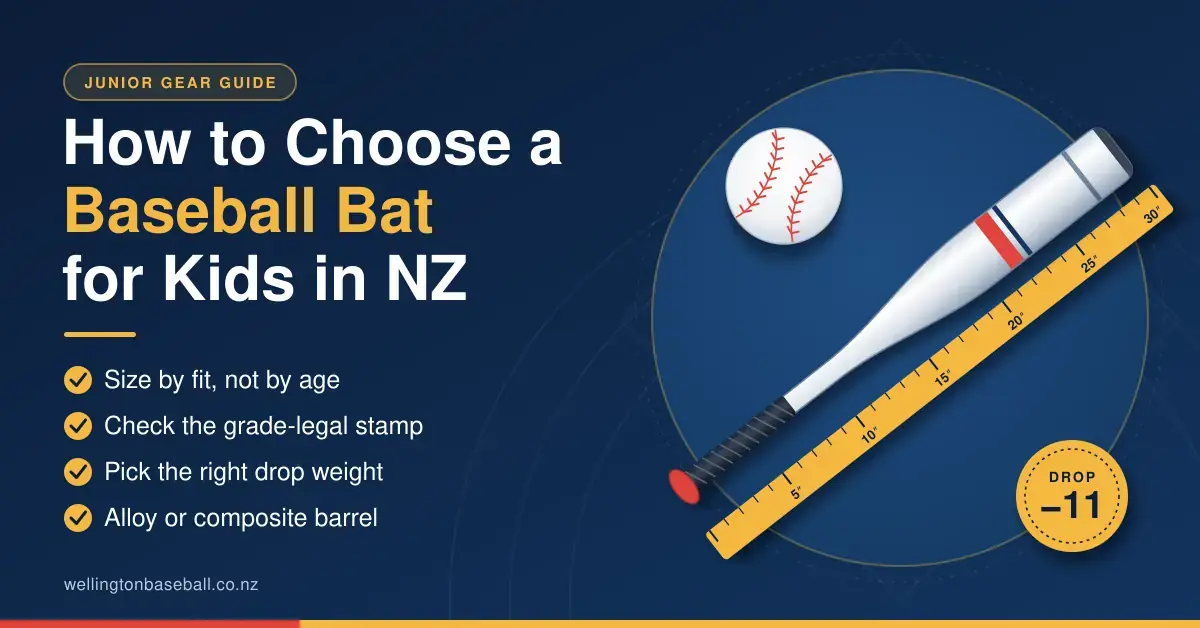
Picking a bat for a young player in New Zealand comes down to two things: matching the bat to the child’s height and strength, and making sure it is legal for the grade they play in. A bat that is too heavy wrecks swing mechanics and knocks a child’s confidence, while one that is too light robs them of the pop needed to drive the ball into the outfield. This guide walks parents through the sizing tests coaches actually use, the certification stamps that matter for junior play here, the difference between alloy and composite barrels, and where to buy gear in a market where baseball equipment can be hard to find.
Key Points
- Certification first: for junior grades, look for the “USA Baseball” (USABat) stamp; avoid USSSA 1.15 BPF bats.
- Size by fit, not age: use the arm-extension test — knob on the chest, barrel just reaching the fingertips.
- Drop weight: higher drops (−11 to −13) are lighter and suit younger players; BBCOR is always a fixed −3 for senior grades.
- Material: alloy is durable, affordable and cold-tolerant; composite gives a bigger sweet spot but needs a break-in and warmth.
- Weight check: if the child cannot hold the bat out to the side for 20 seconds, it is too heavy.
Bat certifications that matter for junior baseball in NZ
The single most important check happens before you even think about size. Junior baseball in New Zealand is run through Baseball New Zealand’s Little League pathway for players roughly aged 10 to 16, and Wellington Baseball is one of the regional associations that feeds into it. Little League worldwide uses the USABat standard, which means non-wood bats must carry the “USA Baseball” stamp. These bats are engineered to perform like wood, capping how fast the ball leaves the barrel so the game stays safe and rewards skill over technology.
Using a bat without the correct stamp can see a player pulled from a game or a tournament, so this is never worth guessing on. Baseball itself is still a smaller sport here than cricket or rugby — you can read a general overview of the game on Wikipedia — which is exactly why checking your club’s gear list first saves an expensive mistake. If you are still weighing up the grades and how the season works, our overview of Little League baseball in Wellington is a good starting point.
USABat, USSSA and BBCOR explained
Three acronyms cause most of the confusion. USABat is the youth standard used in Little League and is the one you want for junior club play here. USSSA bats carry a “1.15 BPF” stamp, allow a livelier trampoline effect (several mph more exit velocity) and are popular in some American travel leagues — but they are not legal in Little League or USA Baseball–sanctioned play, so avoid them for sanctioned games in New Zealand. BBCOR is the standard for the oldest grades and is a fixed −3 drop; it caps the barrel’s energy return at 0.50 and is required for high-school–age and senior players.
| Certification | Where it is used | Key characteristic |
|---|---|---|
| USABat | Little League / junior club grades | Wood-like performance; barrel up to 2 5/8 inches |
| BBCOR .50 | Oldest youth / high-school / senior | Fixed −3 drop, reduced trampoline effect |
| Wood | All levels (and training) | Traditional feel, small sweet spot |
| USSSA 1.15 BPF | US travel ball only | Higher exit speed; not permitted in sanctioned NZ junior play |
Getting the length right
A bat that is the wrong length stops a child covering the whole strike zone. The quickest check is the arm-extension test: have the child stand tall, place the knob against the centre of their chest and point the bat straight out to the side. If they can comfortably reach the end of the barrel with their fingertips, the length is about right. If the barrel sits well past their palm it is too long and hard to control; if they can only touch it near the wrist it is too short and they will struggle with pitches on the outer half of the plate.
Bat Sizing Quick Reference
| Child height | Suggested length | Typical drop | Approx. age |
|---|---|---|---|
| 100–110 cm | 24–25 inch | −12 to −13 | 5–7 (T-ball) |
| 110–125 cm | 26–27 inch | −11 to −12 | 8–9 |
| 125–140 cm | 27–29 inch | −10 to −11 | 10–11 |
| 140–155 cm | 29–31 inch | −8 to −10 | 12–13 |
| 155 cm + | 31–33 inch | −3 to −5 | 14+ |
Guide only — always confirm the fit with the arm-extension and one-handed hold tests, and check your grade’s certification rules.
Resist the urge to buy a bat the child can “grow into.” An oversized bat forces the hands to cast away from the body, producing a slow, loopy swing that cannot catch up to faster pitching. A correctly sized bat keeps the hands inside the ball for a short, compact, repeatable swing — the same habits reinforced in our top hitting tips for baseball players. As a rough guide, a player around 4 feet tall usually suits a 27–28 inch bat, but always confirm with the test above rather than relying on age alone.
Drop weight and swing weight
The most misunderstood number on a bat is the “drop.” The drop is the length in inches minus the weight in ounces, written as a negative number. A 30-inch bat weighing 20 ounces is a drop −10. A higher drop (−12 or −13) means a lighter bat that is easier to swing quickly, which is why younger players start there. As kids get stronger they move toward lower drops to add mass. Because hitting is governed by force = mass × acceleration, a lighter bat a child can accelerate will almost always out-hit a heavy bat they drag through the zone.
| Drop weight | Feel | Typical player |
|---|---|---|
| −12 / −13 | Ultra-light | T-ballers and brand-new hitters |
| −11 / −10 | Balanced | Standard Little League players |
| −8 / −5 | Heavier, more mass | Stronger 11–13 year olds moving up |
| −3 (BBCOR) | Heaviest, fixed by rule | Senior and high-school grades |
Alloy, composite or hybrid barrels
Junior bats come in three material types. Alloy (aluminium) bats are usually one-piece, ready to hit straight out of the wrapper, durable and affordable, with a crisp “ping.” Composite (carbon-fibre) bats are often two-piece, offer a larger sweet spot and dampen the sting on off-centre hits, but they cost more, need a break-in period of roughly 150–200 hits, and are sensitive to cold. Hybrid bats pair a composite handle with an alloy barrel to blend the two.
| Material | Pros | Cons |
|---|---|---|
| Alloy | Affordable, durable, ready to use immediately | Smaller sweet spot, more hand vibration |
| Composite | Large sweet spot, very low vibration | Pricey, needs break-in, cold-sensitive |
| Hybrid | Good vibration damping, balanced feel | Middle-ground price, can feel a touch heavier |
For most cold, damp Wellington mornings early in the season, a durable alloy bat is the more resilient choice. If you go composite, keep it warm before use — more on that in the maintenance section below.
Barrel diameter and bat construction
Two more spec choices round out the decision. Barrel diameter under the USABat standard maxes out at 2 5/8 inches, and most junior bats are either the traditional 2 1/4 inch or the larger 2 5/8 inch “big barrel.” A bigger barrel gives a longer sweet spot and more confidence, but it also adds weight, so it is not automatically better; check that your specific grade permits big barrels before buying. The 2 3/4 inch barrels sold for USSSA travel ball are not legal in sanctioned junior play here.
| Barrel size | Common use | Status in NZ junior play |
|---|---|---|
| 2 1/4 inch | T-ball and junior | Always legal |
| 2 5/8 inch | Older youth grades | Allowed under USABat (check grade) |
| 2 3/4 inch | USSSA travel ball | Not permitted in sanctioned play |
Construction matters for feel. One-piece bats are stiff and transfer energy efficiently, giving strong hitters clear feedback. Two-piece bats flex slightly for a whip effect and, more usefully for kids, absorb vibration. A young player who fears the “sting” of a cold-weather hit will often flinch or swing tentatively, so a two-piece composite or hybrid can keep them aggressive at the plate.
Where to buy baseball bats in New Zealand
Specialist baseball gear is harder to find here than rugby or cricket equipment, and general sports stores sometimes carry older, non-compliant models. Dedicated retailers such as The Dugout, a long-running New Zealand baseball and softball specialist, and Players Sports are the most reliable places to find current USABat-certified bats. Buying locally also makes warranty claims far easier — most premium bats carry a one-year manufacturer’s warranty, and returning a cracked composite to a NZ store beats shipping it back overseas.
| Source | Typical price band | Reliability |
|---|---|---|
| NZ specialist retailer | Higher | High — current stamps and local warranty |
| International online | Medium | Check certification and shipping carefully |
| Second-hand / club swap | Lowest | Variable — inspect for cracks and dents |
If you are buying from an overseas site or a marketplace such as Trade Me, verify the “USA Baseball” stamp in the listing photos before you commit. Many Wellington clubs also run demo days where kids can try several bats — a great chance to test fit before spending. For families still finding their feet in the sport, our guide to getting your child into baseball in NZ covers the wider gear list too.
Testing weight and knowing when to upgrade
Before you pay, run a simple strength test. Have the child grip the handle just above the knob with their top (dominant) hand and hold the bat straight out to the side, parallel to the ground, for about 20 seconds. If the barrel dips or their arm shakes, the bat is too heavy. A bat a child cannot control makes them drop the back shoulder and swing on an uppercut path — one of the hardest habits to unlearn. Balanced bats (weight near the hands) suit beginners far better than end-loaded models.
Kids typically outgrow a bat every 18 to 24 months. Signs it is time to move up include consistent contact with no power, the bat looking small in their hands, or a growth spurt that leaves them reaching for outside pitches. Re-run the arm-extension and strength tests at the start of every season, and listen for “bat death” — alloy that has thinned out or composite with broken-down fibres often turns a sharp ping into a dull thud.
Caring for the bat and cold-weather rules
A quality bat is a real investment, so protect it. Never use a game bat with weighted or “sand” training balls — they dent alloy and crack composite. Keep it out of hot cars and freezing garages, store it in a padded bag, and discourage tapping cleats with the barrel. Composite bats deserve special care in the cold: most manufacturers advise against using them below about 15°C (60°F), with a few rating them down to 10°C, because chilled carbon fibre and denser cold baseballs both raise the risk of cracking. On frosty Wellington mornings, warm up with an alloy backup and save the composite for once the day has warmed.
Good habits protect players as well as gear. Pair bat care with our wider baseball safety tips for kids in Wellington, and if you are kitting out a young player from scratch, the same care principles apply when you break in a new glove.
Reference sources
Frequently Asked Questions
What bat certification do kids need in New Zealand?
For most junior club and Little League grades, the bat must carry the “USA Baseball” (USABat) stamp. The oldest grades typically require a BBCOR bat instead. USSSA 1.15 BPF bats are not permitted in sanctioned junior play, so always check your club’s gear list first.
What size bat should a 10-year-old use?
Most 10-year-olds land on a 27 to 29 inch bat with a −10 or −11 drop, but height and strength vary a lot at that age. Use the arm-extension test and the one-handed hold test rather than choosing by age alone.
What does “drop weight” mean?
Drop weight is the bat’s length in inches minus its weight in ounces, expressed as a negative number. A 30-inch bat weighing 20 ounces is a drop −10. A higher drop means a lighter, easier-to-swing bat.
Is alloy or composite better for a beginner?
Alloy is usually the smarter first bat: it is cheaper, tougher, ready to use immediately and copes better with cold, damp conditions. Composite offers a bigger sweet spot and less sting but costs more, needs breaking in, and can crack in the cold.
When should my child move up to a new bat?
Roughly every 18 to 24 months, or after a growth spurt. Upgrade when they make solid contact without power, the bat looks small in their hands, they move up a grade, or the hit sounds like a dull thud instead of a sharp ping.