Baseball and softball look almost identical from the stands — a diamond, a bat, nine fielders and a pitcher trying to beat a hitter. They come from the same family and share the same basic objective, but they are two different games with their own balls, field sizes and pitching rules. In short: softball uses a larger, less dense ball thrown underhand over a shorter distance, while baseball uses a smaller, harder ball thrown overhand from a raised mound. In New Zealand the choice matters in a practical way too — softball has been played here since the 1930s and has clubs in most regions, while baseball is a smaller but growing summer code. This guide sets out the key differences and helps you decide which one to pick up.
Key Differences
| Feature | Baseball | Softball (fastpitch) |
|---|---|---|
| Ball | ~23 cm (9 in), 142–149 g | ~30 cm (12 in), 177–198 g |
| Bat | Up to 42 in (107 cm) | Up to 34 in (86 cm) |
| Bases apart | 90 feet (27 m) | 60 feet (18 m) |
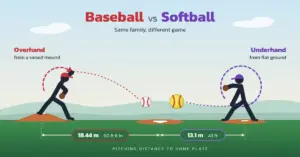
| Pitching distance | 60 ft 6 in (18.44 m) | ~43 feet (13 m), adult women |
| Pitching style | Overhand, from a raised mound | Underhand windmill, from a flat circle |
| Innings | 9 | 7 |
One family, two games
Both sports are overseen worldwide by the same governing body, the World Baseball Softball Confederation (WBSC), and the aim is the same: hit the pitch, run the bases and score more than the other team. Where they split is in the equipment, the size of the field and — most of all — the way the ball is pitched.
It also helps to know that softball itself comes in two forms. Fastpitch is the competitive, Olympic version played at schools, clubs and international level, with a fast underhand windmill delivery. Slowpitch is a more social, slower-paced version, usually played in casual and mixed leagues. The comparisons below use fastpitch softball unless noted, because that is the version most New Zealanders play. If you are brand new to the diamond, our guide on how to play baseball walks through the basics that both codes share.
The ball and the bat
The ball is the clearest difference, and the name is a little misleading — a softball is not actually soft. It is simply bigger and less dense than a baseball:
- Baseball: about 23 cm (9 inches) in circumference and 142–149 g.
- Softball: about 30 cm (12 inches) in circumference and 177–198 g — larger and heavier overall, but less dense for its size.
The bats differ in size to match. A baseball bat can be up to 42 inches (107 cm) long, while a softball bat is shorter — no longer than 34 inches (86 cm). If you are shopping for junior gear, our guide to choosing a baseball bat covers the length, weight and rules to look for.
Pitching: overhand power vs the windmill
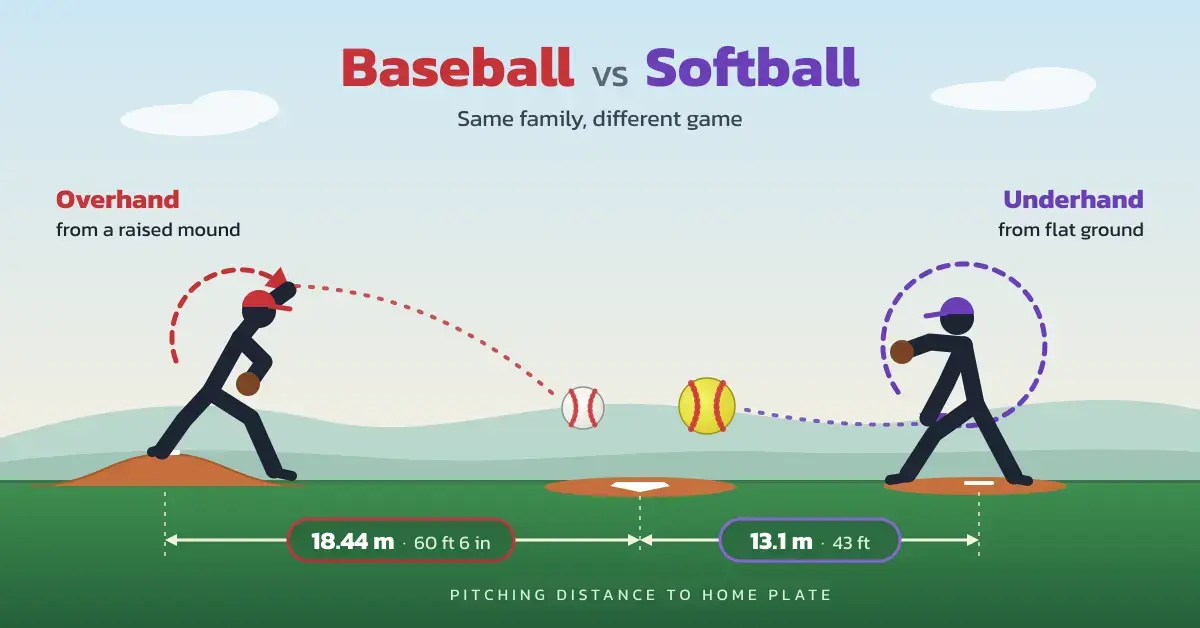
This is the single biggest difference between the two games. A baseball pitcher throws overhand from an elevated, sloping mound, with the rubber 60 feet 6 inches (18.44 m) from home plate. A softball pitcher throws underhand, using a full windmill motion, from a flat pitching circle that is much closer — about 43 feet (13 m) for adult women.
Because the softball travels a shorter distance, the two deliveries reach the batter in a surprisingly similar amount of time, even though a baseball is pitched faster (often above 90 mph, versus roughly 60 mph and up for a softball). In practice that means softball hitters have very little time to react — the shorter distance cancels out much of the slower speed.
The field: bases, mound and fences
A baseball diamond is bigger in almost every dimension. The bases sit 90 feet (27 m) apart in baseball but only 60 feet (18 m) apart in softball, so softball infields are tighter and plays happen faster. The outfield fences follow the same pattern: a baseball fence is often around 400 feet from home plate, while a softball fence is typically closer to 220 feet.
The pitching area differs too. Baseball pitchers work off a raised mound, which lets them throw downhill; softball pitchers deliver from a flat circle on the same level as the batter. For a beginner, the smaller softball field is part of what makes it an easy sport to start in a local park.
Innings and game length
A regulation baseball game runs nine innings, while softball games are seven. A softball game can also finish early when one team builds a big lead — for example a 15-run lead after three innings or a seven-run lead after five — while a baseball game that is still tied after nine innings goes into extra innings until there is a winner. If you want a sense of how long a game actually takes on the clock, see our breakdown of how long a baseball game lasts.
Playing baseball or softball in New Zealand
In Aotearoa the two codes are not evenly matched for size or history. Softball has a much deeper footprint: the game was introduced to workers at the Ford Motor Company plant at Seaview, near Petone, by Canadian production manager Bill “Pop” Wilson, and the first public game was played on 2 October 1937 at Wellington’s Winter Show Grounds. Today it is run nationally by Softball New Zealand. The sport has a strong international record — the men’s Black Sox and women’s White Sox have both been among the best teams in the world — and there are club and school competitions, plus clear junior pathways (Under-15, Under-18 and Under-23), in most regions. For the women’s game at the top level, see our guide to the Softball World Cup.
Baseball has a smaller but growing presence here. As we see it across the Wellington clubs, it is run through Baseball New Zealand and its regional associations and played mainly over summer. In the Wellington region, families usually start children in the junior grades — our guide to Little League baseball in Wellington explains registration, grades and fees, and you can see the wider pathway in our overview of baseball competitions in NZ for youth players.
Which one should you choose?
There is no single right answer — it depends on what is available near you and what you enjoy. A few pointers:
- If you want the easiest sport to find a local club or school team in New Zealand, softball usually has more options and a longer-established network.
- If you specifically want the game you watch in Major League Baseball — overhand pitching, the bigger field, wooden bats — look for a baseball club in one of the main centres, including Wellington.
- If you are enrolling a child, both codes have welcoming junior grades; the deciding factor is often simply which club trains closest to home.
- If you want a relaxed, social game, slowpitch softball is the gentlest way in, with its slower, more easygoing pace.
Many of the core skills — throwing, catching, fielding grounders and reading the bounce — carry over between the two sports, so trying one is never wasted if you later switch.
Sources
Frequently Asked Questions
Is softball popular in New Zealand?
Yes. Softball is one of New Zealand’s long-established summer diamond sports, with a national governing body, club and school competitions in most regions, and a strong international history through the Black Sox and White Sox. As we see it, it has a wider club footprint across the country than baseball, which is a smaller but growing code.
Is a softball actually soft?
No. A softball is larger and slightly less dense than a baseball, but it is still firm and can sting if it hits you — the “soft” in the name does not mean the ball is soft to the touch.
Can you use a baseball glove for softball?
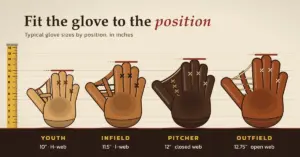
You can at a casual level, but a dedicated softball mitt is usually a better fit for the larger ball. Many players find they get a more secure catch with one once they are playing regularly, so it is worth switching if you stick with the sport.
What is a pickle in softball?
A pickle, also called a rundown, is when a base runner is caught between two bases and the fielders throw the ball back and forth to tag them out before they can reach safety. It happens in baseball too and is one of the most exciting plays to watch.
Is baseball or softball harder to hit in?
Neither is simply easier. Baseball pitches are faster, but softball is thrown from much closer, so batters in both sports get a similar, very short time to react. Each takes its own timing and practice to master.