Choosing a baseball glove comes down to four things: the position you play, your hand size or age, the web style that suits that position, and the leather or material the glove is made from. Get those right and the glove will feel like part of your hand; get them wrong and even an expensive glove will let balls pop out or slow your throws. This guide walks New Zealand players and parents through each decision, with size ranges you can check against your own hand and tips on where to buy locally.
Key Points
- Position first: choose the glove size and web for where you field, then fit it to your hand.
- Typical adult sizes: infield 11.25–12″, outfield and first base 12–13″, pitcher 11.5–12″, catcher’s mitt 32–34″ circumference.
- Web style matters: closed webs hide a pitcher’s grip, I-web and H-web suit infielders, deep open webs suit outfielders.
- Youth players: size to the hand now (roughly 9–12″ by age) — never buy oversized to “grow into”.
- Material: synthetic is cheap and game-ready; leather lasts longer but needs breaking in.
- Always check the fit on your non-throwing hand before buying.
How baseball gloves are measured
A fielding glove is measured in inches, from the tip of the index finger, down along the palm, to the heel of the glove where it meets your wrist. That length — printed on the thumb or pinky of most gloves — is what people mean when they talk about an “11.5-inch” or “12.75-inch” glove. It is not the size of your hand; it is the reach and pocket the glove gives you.
Catcher’s and first baseman’s gloves are the exception. These are “mitts” rather than gloves: they have no separate fingers and far more padding, and catcher’s mitts are sized by the distance around the outside edge (the circumference), which is why their numbers run much larger — roughly 32 to 34 inches for adults. If you are still learning the layout of the field, our guide to baseball position numbers explains how the nine fielding spots fit together.
Choosing a glove by position
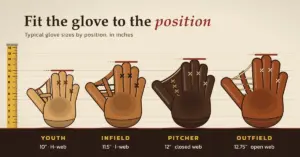
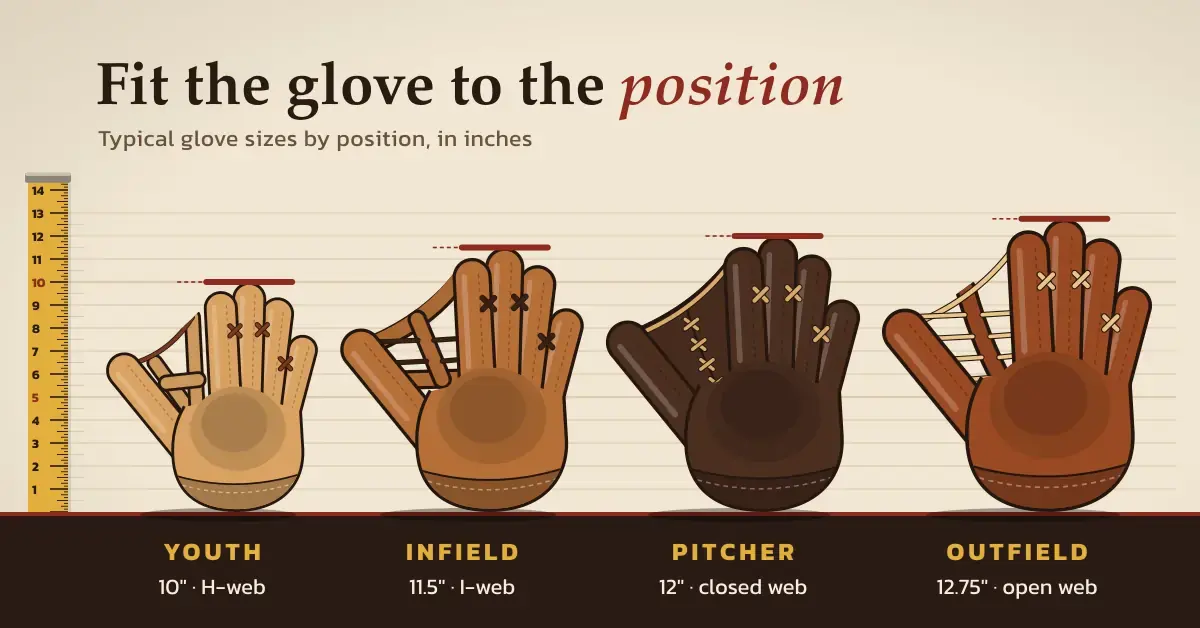
Position is the first filter, because each role needs a different balance of size, pocket depth and speed. Infielders want small, shallow gloves for quick transfers; outfielders want large, deep gloves to reach and hold fly balls; specialist spots (pitcher, first base, catcher) have their own shapes.
Glove Size by Position
| Position | Typical adult size | Common web styles | Why |
|---|---|---|---|
| Second base / shortstop | 11.25–11.5″ | I-web, single post | Shallow pocket for fast transfers and throws |
| Third base | 11.5–12″ | H-web, I-web | A little more reach on hard-hit balls |
| Outfield | 12–13″ | H-web, trapeze | Long reach and a deep pocket to trap fly balls |
| Pitcher | 11.5–12″ | Closed, basket, two-piece | A solid web hides the grip from the batter |
| First base | 12–13″ (mitt) | Single / dual post | Long, curved scoop to pick low throws |
| Catcher | 32–34″ (circumference) | Closed / solid web | Heavy padding to absorb pitches and frame targets |
Infield (second base, shortstop, third base)
Middle infielders at second base and shortstop usually choose gloves around 11.25 to 11.5 inches with a shallow pocket, so the ball sits near the surface and can be pulled out and thrown in a fraction of a second. Third basemen often go slightly larger, about 11.5 to 12 inches, for a bit more reach on hard-hit balls down the line.
Outfield
Outfielders need the longest fielder’s gloves, typically 12 to 13 inches, with a deep pocket. The extra length adds reach on balls hit to the gap, and the deep pocket helps trap a fly ball so it does not bounce out on the catch.
Pitcher
Pitchers use mid-sized gloves of about 11.5 to 12 inches, almost always with a closed web. A solid web hides the grip on the ball so the batter cannot read whether a fastball or a breaking ball is coming.
First base
A first baseman’s mitt is long and curved — roughly 12 to 13 inches — with a scoop shape and a deep pocket designed to pick low throws out of the dirt and stretch for wide ones. Like a catcher’s mitt, it has no individual fingers.
Catcher
A catcher’s mitt is a heavily padded, round, claw-shaped mitt measured by circumference, usually 32 to 34 inches for adults. The padding absorbs pitch after pitch and the stiff shape helps present a clear target. If you are weighing up the role, our page on the catcher covers what the position demands.
Sizing for children and youth players
For juniors, the golden rule is: never buy a glove the child will “grow into”. An oversized glove is heavy, floppy and almost impossible to close, which teaches poor fielding habits. Size to the hand now, and replace it as the child grows.
As a rough starting point, players seven and under do well with gloves around 9 to 10.5 inches, eight to ten-year-olds around 10.5 to 11.5 inches, and eleven to thirteen-year-olds around 11 to 12 inches depending on where they field. These are guides only — children’s hands vary, so have the player try the glove on and make sure they can squeeze it shut. Families just getting started can find local grades and registration details in our guide to Little League baseball in Wellington, and if you are buying a bat at the same time, see how to choose a baseball bat for kids.
Web and pocket styles explained
The “web” is the lattice of leather between the thumb and index finger. It controls how deep the pocket is, how much the glove flexes and — for pitchers — whether the ball is hidden. The common styles are:
- I-web: a single vertical strip between two horizontal pieces. It keeps the pocket shallow for fast transfers, so it is a favourite of middle infielders.
- H-web: two vertical strips with a horizontal bar between them. It is versatile — popular with third basemen and especially outfielders.
- Trapeze and modified trapeze: an open, deep web that suits outfielders tracking fly balls.
- Closed, basket and two-piece webs: solid webs that conceal the ball. They are mainly used by pitchers, and on many youth gloves.
- Single and dual post: cross-shaped webs often seen on infield and first base gloves.
Pocket depth follows the position too: infield gloves keep the pocket shallow for speed, while outfield, first base and catcher’s gloves run deeper to hold the ball securely.
Leather, build quality and whether price matters
Material decides how a glove feels out of the box, how long it lasts and how much it costs:
- Synthetic or treated leather: light, inexpensive and soft straight away, so it is ideal for beginners and young children. It is the least durable option and wears out faster than leather.
- Standard cowhide: a good middle ground — durable, with a reasonably quick break-in. This is where most club players land.
- Premium leather (such as steerhide or kip): stiff and demanding when new, but it holds its shape and can last many seasons once broken in.
So does a more expensive glove make a difference? For a committed player, better leather holds its pocket and lasts longer, which can be worth it. For a beginner or a growing child, a mid-range or synthetic glove is the smarter buy — the fit and the right size matter far more than the price tag. Whichever you choose, a new leather glove will feel stiff at first; set aside time to break in a baseball glove before game day. In the variable New Zealand climate, wipe a damp glove dry and condition the leather occasionally so it does not stiffen or crack.
Getting the fit right
You wear the glove on your non-throwing hand — a right-handed thrower wears the glove on the left hand, and vice versa. Once you have the right size and style, check the fit before you buy:
- Your fingers should reach the finger stalls without being cramped, and your hand should not slide too deep into the glove.
- You should be able to open and, more importantly, fully close the glove with one squeeze.
- The wrist strap or lacing should pull snug so the glove stays put when you run.
- With a youth glove, the hand opening should be small enough that the child controls the glove rather than the glove controlling them.
Where to buy a baseball glove in New Zealand
Baseball gear is more of a specialist buy here than in North America, but it is available. Dedicated softball and baseball retailers such as Players Sports stock fielding gloves, catcher’s mitts and first baseman’s mitts from brands including Rawlings, Franklin and Ace Sport, and ship nationwide. On Players Sports’ softball and baseball listing, fielding gloves start at around NZ$85, while premium leather fielding gloves run up to about NZ$300. Prices and stock change, so check the current listing before you order, and where possible try the glove on your hand first.
Sources
Frequently asked questions
What’s the difference between a baseball glove and a mitt?
A glove has individual fingers and is used by pitchers, infielders and outfielders. A mitt has no separate fingers and extra padding, and only catchers and first basemen use one. The mitt’s shape is built to trap and protect rather than to transfer the ball quickly.
Is an 11.5-inch glove too small for third base?
No. An 11.5-inch glove sits at the smaller end of the usual third-base range, which runs to about 12 inches. Many third basemen prefer 11.75 to 12 inches for a little more reach on hard-hit balls, but 11.5 inches is perfectly playable, especially for younger or smaller players.
How do I choose a glove for a left-handed thrower?
Gloves are labelled by throwing hand, not by the hand they go on. A left-handed thrower needs a “left-hand throw” (LHT) glove, which is worn on the right hand, while a right-handed thrower needs a “right-hand throw” (RHT) glove, worn on the left. Left-hand-throw gloves are less common in shops, so you may need to order one in.
What size glove do most adults use?
Most adult fielders use a glove between 11.25 and 13 inches depending on position — see the size-by-position table above for the right range for each spot.