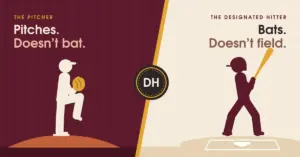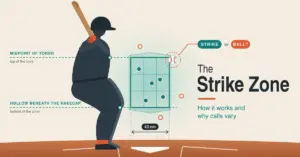
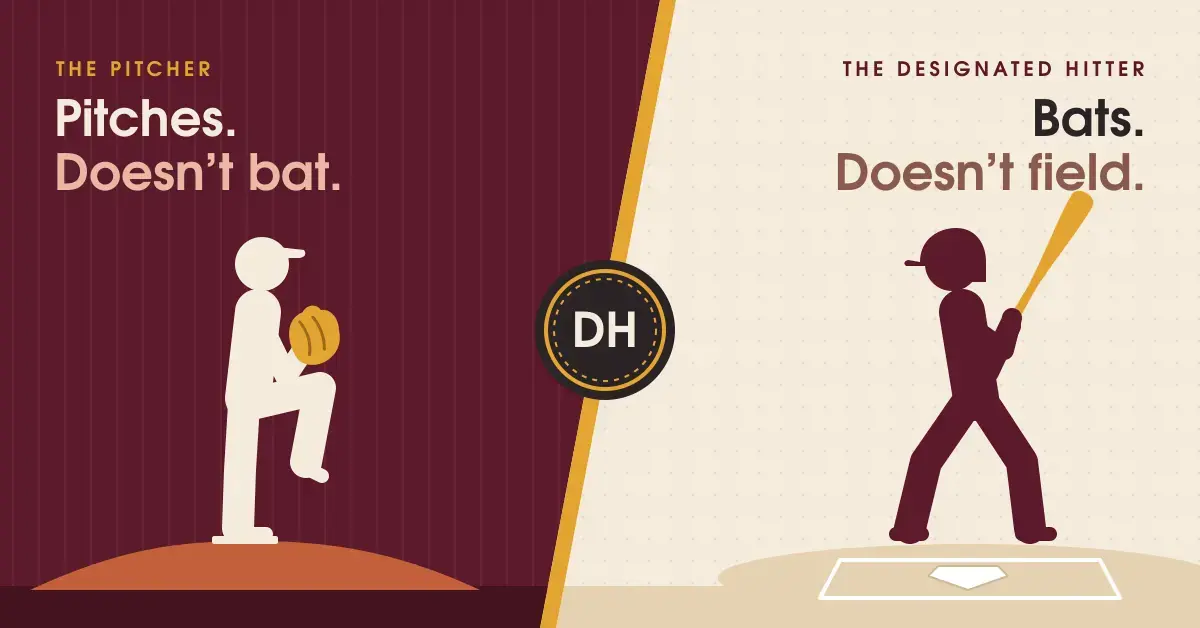
The designated hitter (DH) is a player who bats in place of the pitcher but does not field a position. The designated hitter rule is one of the most important — and most argued-over — rules in modern baseball, because it changes who comes to the plate, how managers build a lineup, and how long star players can keep their careers going. This guide explains what the DH rule is, how it works, where it came from, and how it differs across Major League Baseball (MLB), college, high school, and international play.
What is a designated hitter?
In baseball, nine players normally take the field on defence, and the same nine take turns batting. Traditionally that included the pitcher, who is usually a weak hitter because their training is built around throwing, not swinging a bat.
The designated hitter is a tenth player added to the batting side only. The DH takes the pitcher’s spot in the batting order and bats every time that slot comes up, while the pitcher stays in the game to pitch but never has to hit. The DH does not play a defensive position and does not have a fielding number in the standard 1–9 fielding system.
The simple goal of the rule is to put a stronger bat in the lineup where a pitcher would otherwise be, which tends to produce more offence and keeps pitchers from risking injury while batting or running the bases.
How the designated hitter rule works
The DH is covered by Official Baseball Rule 5.11. The key mechanics are straightforward once you see them in order:
- A team may choose to use a designated hitter for its pitcher. Using a DH is optional, but it must be decided before the game and listed on the lineup card.
- The designated hitter must be named in the starting lineup. A player not listed as the DH at the start cannot become one later.
- The DH bats in a fixed spot in the order for the whole game. Managers can pinch-hit or substitute for the DH, but the new player simply inherits the DH role.
- The pitcher never bats while a DH is in use, no matter how many pitchers a team uses during the game.
- The role of DH is lost for the rest of the game if the player who is the DH later moves into the field to play defence.
Because the DH adds a bat without adding a fielder, a team using the rule effectively has ten players involved rather than nine — a detail that connects to how a club manages its wider roster.
Key Points
- What it is: the designated hitter (DH) bats in place of the pitcher and does not field a position.
- Rule: Official Baseball Rule 5.11; using a DH is optional but must be declared in the starting lineup.
- Origin: adopted by the American League in 1973; Ron Blomberg was the first DH.
- Universal DH: both MLB leagues have used a DH in every game since 2022.
- Ohtani rule: a player can be listed as pitcher and DH at once, and keep batting after leaving the mound.
- Key limit: the pitcher never bats while a DH is in use, and a DH who takes the field loses the role.
The history of the designated hitter
The DH was created to add offence at a time when run-scoring and attendance were seen as too low. The American League (AL) voted to adopt the rule on 11 January 1973, originally as a three-year trial. Ron Blomberg of the New York Yankees is credited as the first designated hitter in MLB history, batting on 6 April 1973 against the Boston Red Sox.
For decades this created a split in the major leagues: the American League used the DH, while the National League (NL) kept making pitchers bat. That difference was one of the most distinctive quirks of baseball, and it shaped strategy, trades, and even how fans argued about the game for nearly fifty years.
The National League used a designated hitter only temporarily during the pandemic-shortened 2020 season, then reverted to letting pitchers bat in 2021. The permanent, league-wide change came in 2022: as part of the collective bargaining agreement, MLB adopted the universal DH, meaning both the American and National Leagues now use a designated hitter in every game. Pitchers batting in the majors is, for now, a thing of the past.
The “Ohtani rule”: designated hitters who also pitch
A normal DH and the pitcher are two different people. Under the standard rule, once a starting pitcher is removed from the mound, they are out of the game entirely, and a DH who takes the field as a fielder loses the DH role.
That created a problem for genuine two-way players — athletes who both pitch and hit at a high level. The most famous is Shohei Ohtani. To let such players do both in the same game, MLB and the players’ association agreed in 2022 to an exception, widely nicknamed the “Ohtani rule” (Rule 5.11(b)).
Under this exception, a player can be listed as both the starting pitcher and the designated hitter at the same time. If the manager later takes that player off the mound, they can stay in the game and keep batting as the DH. The lineup card has to show the player in two spots — once as the pitcher and once as the DH. The idea was first tried in the 2021 All-Star Game, when Ohtani started as both pitcher and DH and remained as a hitter after leaving the mound.
The exception matters because, without it, a two-way star would have to give up hitting the moment they were relieved on the mound. The rule lets a club get a full day of pitching and a full day of hitting from one roster spot — a flexibility that paid off on baseball’s biggest stage, including Ohtani’s two-way outings in the World Series.
The designated hitter across leagues and levels
The DH is not a single, universal rule. Different leagues apply their own versions, and the details change how teams use it. The table below compares the main ones.
DH Rules by League
| League / level | Designated hitter status | Notes |
|---|---|---|
| MLB (American League) | Used since 1973 | First league to adopt the DH |
| MLB (National League) | Universal DH since 2022 | Pitchers batted until then (except a temporary 2020 season) |
| NPB Pacific League (Japan) | Used since 1975 | Japan’s first DH league |
| NPB Central League (Japan) | Adopting DH from 2027 | Voted in August 2025; 2026 is a transition year |
| World Baseball Classic | DH used | Adopts Official Baseball Rule 5.11 |
| NCAA college (US) | DH used | A pitcher may also bat for himself as a pitcher/DH |
| High school (US, NFHS) | DH used, flexible | DH may bat for any defensive player and can also field |
| Youth / amateur | Varies | Often an extra hitter or continuous batting order instead |
Nippon Professional Baseball (Japan)
Japan’s top competition, Nippon Professional Baseball (NPB), was split for decades just as MLB once was. The Pacific League has used the DH since 1975, while the Central League kept pitchers batting. In August 2025 the Central League’s clubs voted unanimously to adopt the designated hitter from the 2027 season, with 2026 treated as a transition year. Once that takes effect, both of Japan’s leagues will share the same rule for the first time since 1975.
College and high school baseball (United States)
College baseball (NCAA) uses a DH that bats for the pitcher, but it also allows a strong-hitting pitcher to bat for themselves as a combined pitcher/DH, in which case they are treated as two players on the lineup card. High school rules in the United States (set by the NFHS) take a more flexible approach: since a 2020 change, the designated hitter can also be a starting defensive player, and the DH may be used for any defensive player rather than only the pitcher.
International and amateur play, including New Zealand
Top international events use the DH. The World Baseball Classic adopts Official Baseball Rule 5.11, so a designated hitter is used in tournament games. Many amateur and youth competitions use their own variations: a DH that can bat for any fielder, an “extra hitter” (EH) that simply adds a tenth batter to the order, or a continuous batting order in which every player on the roster bats. Kiwi players moving between grades should always check the specific rules of their competition, which may differ from the MLB version. A good place to build this kind of vocabulary is a plain-language glossary of baseball terms.
Why the designated hitter is debated
Few rules divide baseball fans as sharply as the DH. The arguments on each side are mostly about strategy versus offence.
Supporters of the DH point to:
- More offence, because a trained hitter replaces a weak-hitting pitcher in the lineup.
- Fewer pitcher injuries from batting, running, or sliding.
- Longer careers for powerful hitters who can no longer field well, keeping popular players in the game.
- Fewer predictable, low-value plate appearances and sacrifice bunts by pitchers.
Critics of the DH argue:
- It removes strategy, such as when a manager must decide whether to pinch-hit for a pitcher in a close game.
- It takes away the “double switch” and other tactical lineup moves tied to the pitcher’s spot.
- It separates the game into pure hitters and pure pitchers, losing the all-round skill of players who can do both.
Both views are legitimate, and MLB’s long AL–NL split is the clearest evidence that reasonable people disagreed for decades before the universal DH settled the major-league question in 2022.
Common misunderstandings about the DH
A few points trip up newer fans:
- The DH only replaces the pitcher’s bat, not the pitcher. The pitcher still pitches; the DH never fields.
- Using a DH is a choice, not a requirement. A team can decline to use one, but then its pitcher must bat.
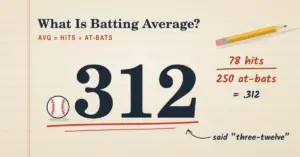
- A DH’s hits still count fully. Hits, home runs and runs batted in by a DH count exactly like any other batter’s, and they factor into stats such as RBI and batting average.
- The 2020 National League DH was temporary. The permanent universal DH did not arrive until 2022.
Who the designated hitter role suits
The DH is often a team’s best pure hitter who is a below-average or ageing defender — a player whose bat is too valuable to leave out but whose fielding would cost runs. It can also be a way to rest a regular from the physical strain of fielding while keeping their bat in the lineup, or to ease an injured player back into action. In the rare case of a true two-way star, the “Ohtani rule” lets the same player serve as both the pitcher and the DH, which is as much a roster advantage as a personal showcase.
Reference sources
- MLB.com — Designated Hitter Rule (official glossary)
- Baseball-Reference — Designated Hitter
- SABR — 50th anniversary of the designated hitter in MLB
- MLB.com — The “Ohtani rule” among 2022 changes
- The Japan Times — Central League votes to adopt the DH from 2027
- NFHS — Expanded designated hitter role in high school baseball
- MLB.com — World Baseball Classic rules and regulations
Frequently Asked Questions (FAQ)
What does the designated hitter rule do?
It lets a team use an extra batter, the designated hitter, to bat in place of the pitcher. The pitcher still pitches but never comes to the plate, and the DH bats in a fixed spot in the order without playing defence. The aim is to add a stronger bat to the lineup.
When did MLB adopt the designated hitter?
The American League adopted the DH in 1973, with Ron Blomberg becoming the first DH on 6 April 1973. The National League held out for decades and used it only briefly in 2020 before reverting. A permanent, universal DH for both leagues began in 2022.
What is the “Ohtani rule”?
It is an exception that lets a player start as both the pitcher and the designated hitter in the same game. If the manager removes that player from the mound, they can stay in and keep batting as the DH. It is named after Shohei Ohtani and was written into the rules in 2022.
Does the pitcher still bat when a DH is used?
No. When a team uses a designated hitter, the pitcher does not bat at all. The DH takes the pitcher’s place in the batting order for the entire game, even if the team changes pitchers.
Do all levels of baseball use the designated hitter?
Not in the same way. MLB, Japan’s Pacific League (and the Central League from 2027), the World Baseball Classic, college and high school baseball all use some form of DH, but the details differ. Many youth and amateur leagues use their own versions, such as an extra hitter or a continuous batting order, so always check your competition’s rules.