The strike zone is the single most important piece of space in baseball. Every pitch is judged against it, yet you cannot see it painted on the field — it is an invisible box that floats over home plate and changes shape with each batter. Understanding where that box sits, how a pitch earns a strike, and why two umpires (or a camera and an umpire) can disagree on the same pitch is the fastest way to make sense of what is happening at the plate. This guide explains the strike zone in plain language, from the rulebook definition to the robot-assisted calls now arriving in Major League Baseball.
Key Points
- The strike zone is an invisible box over home plate; a no-swing pitch that passes through it is a strike.
- Its width equals home plate: 43 cm (17 inches). A ball touching any part of the zone counts.
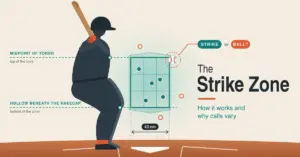
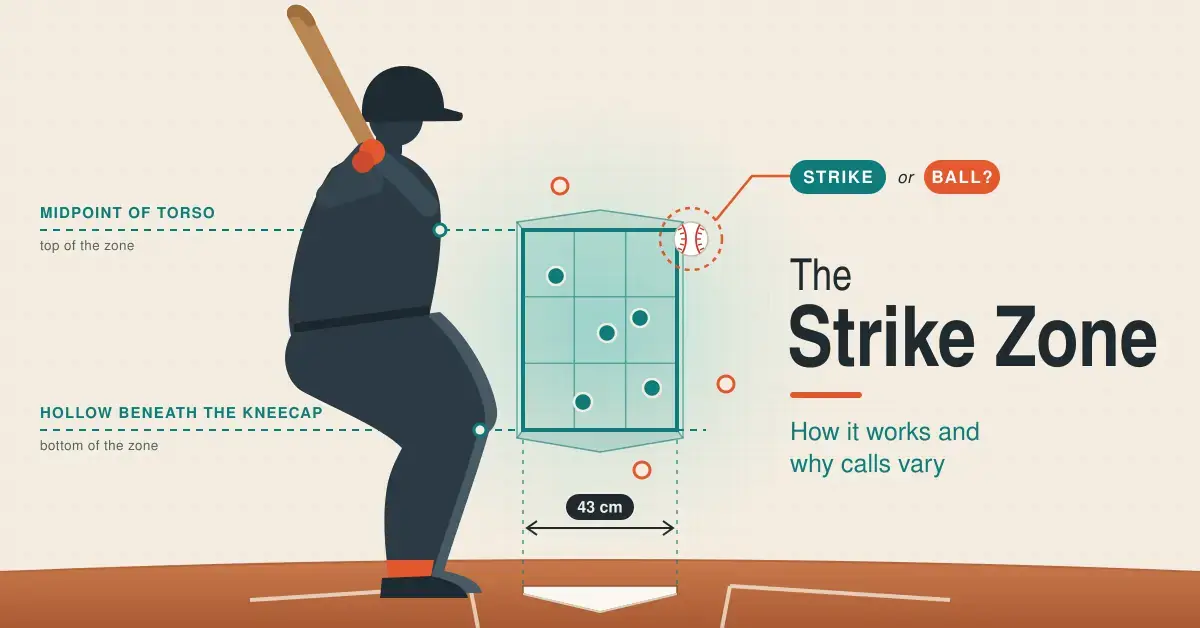
- Top of the zone = midpoint of the torso; bottom = the hollow beneath the kneecap, set by the batter’s stance.
- Three strikes is a strikeout; four balls is a walk.
- Calls vary because of umpire sightline, catcher framing, each batter’s stance, and the 3D-box-versus-flat-reality problem.
- MLB’s ABS challenge system (from 2026) lets teams ask cameras to review close calls — two challenges per team, kept when correct.
What is the strike zone?
The strike zone is the three-dimensional area over home plate through which a pitch must pass to be called a strike when the batter does not swing. Home plate is 43 centimetres (17 inches) wide across its front edge, and that width sets the left-to-right boundaries of the zone. A pitch does not need to pass over the centre of the plate — clipping any edge counts.
According to the Official Baseball Rules, a pitch is a strike if any part of the ball passes through any part of the strike zone before it bounces. That single sentence does a lot of work: a pitch that nicks the outside corner by a centimetre is, by the letter of the rule, exactly as much a strike as one thrown down the middle.
The job of calling that boundary belongs to the home-plate umpire, who crouches behind the catcher and watches each pitch cross the plate. If you are new to the vocabulary around pitching and hitting, our baseball terms glossary is a useful companion to this article.
How the top and bottom are measured
The width of the zone is fixed by the plate, but its height is personal to each batter and is measured from the stance they take as they get ready to swing. The rulebook sets two reference lines:
- Top of the zone: the midpoint between the top of the batter’s shoulders and the top of their uniform pants — roughly the middle of the torso.
- Bottom of the zone: the hollow just beneath the kneecap.
Because those lines are tied to the batter’s body, a tall player has a taller zone than a short one, and a hitter who crouches low shrinks their own zone. This is why you will sometimes see a batter deliberately bend their knees — a lower stance can pull the top of the zone down and take high strikes away from the pitcher. It also means the umpire has to re-set the zone mentally for every hitter who steps in.
Balls, strikes and the count
Every plate appearance is a race between balls and strikes, tracked as “the count” (balls first, then strikes).
- Three strikes and the batter is out (a strikeout).
- Four balls — four pitches outside the zone that the batter does not swing at — and the batter is awarded first base. This is a walk, or base on balls.
A pitch can become a strike in several ways: the batter swings and misses; the batter does not swing at a pitch inside the zone (a “called strike”); or the batter hits the ball foul. Foul balls carry a special rule — a foul counts as a strike when the batter has none or one strike, but with two strikes a foul ball normally does not add a third strike, so a hitter can foul off pitch after pitch to stay alive. The exception is a bunt fouled off with two strikes, which is ruled a strikeout. A foul tip caught cleanly by the catcher is a strike at any count.
Why strike calls vary
If the zone is written into the rules, why do fans, players and broadcasters argue about calls on almost every pitch? Because translating a crisp rule into a live judgment at nearly 160 km/h is genuinely hard. Several factors push calls away from the textbook.
A box in the rulebook, an oval in practice
The written zone is a cube that sits over the whole depth of the plate, but umpires process a pitch as a flash of movement, not a frozen rectangle. In practice the called zone tends to look more like an oval than a sharp-cornered box: pitches that only clip the very top of the back edge or the very bottom of the front edge are often called balls even though they technically touched the zone. The corners, in particular, are where the rulebook and reality diverge most.
Umpire judgment and sightline
The home-plate umpire sees the pitch from one angle, over the catcher’s shoulder, and must decide in a fraction of a second. Small differences in where an umpire sets up, how a pitch moves, and simple human variation all nudge the boundary. Over a long history this produced well-known tendencies — some umpires favoured a slightly wider zone, others a lower one — and league-wide the called zone peaked at about 55.6% of batter height at the top and around 24.2% at the bottom, a little different from the strict rulebook lines.
Pitch framing by the catcher
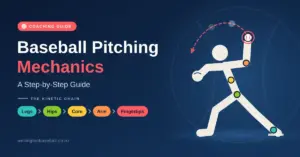
Catchers actively influence calls through framing — the subtle art of receiving a borderline pitch so it looks like a strike, catching the ball with quiet hands and drawing the glove gently toward the zone rather than stabbing at it. A skilled framing catcher can earn his pitcher extra strikes over a season, which is one reason framing is now a prized defensive skill. You can read more about how deliveries are built in our guide to baseball pitching mechanics.
The batter changes the target
Because the zone is set by each hitter’s stance and height, the target literally changes from batter to batter. A compact hitter with a crouch gives the umpire a small, low window; a tall batter standing upright presents a large one. The same pitch location can be a strike to one hitter and a ball to the next.
Strike Zone Comparison
| Feature | Rulebook / umpire zone | ABS electronic zone (2026) |
|---|---|---|
| Shape | Three-dimensional box over the whole plate | Two-dimensional rectangle at the middle of the plate |
| Width | 17 inches (width of home plate) | 17 inches (width of home plate) |
| Top of zone | Midpoint between shoulders and top of pants | 53.5% of the batter’s height |
| Bottom of zone | Hollow beneath the kneecap | 27% of the batter’s height |
| Who decides | Home-plate umpire, by eye | Hawk-Eye cameras, on challenge |
| How a call is reviewed | No review of the original call | Batter, catcher or pitcher taps head to challenge |
| Used at | All levels of baseball | MLB only (spring training, regular season, postseason) |
Robot umpires: the ABS challenge system
To take some of the guesswork out of the closest calls, Major League Baseball approved the Automated Ball-Strike (ABS) challenge system in September 2025 for use across spring training, the regular season and the postseason from the 2026 season. The decision was made by the sport’s Joint Competition Committee after years of testing in the minor leagues (Triple-A since 2022) and trials at 2025 spring training and the All-Star Game.
Importantly, this is a challenge system, not a full robot umpire. The human umpire still calls every pitch. Each team gets a limited number of challenges to ask technology to review a call, and the computer’s ruling is final for that pitch.
How the technology defines the zone is different from the rulebook version. The ABS zone is a two-dimensional rectangle set at the middle of home plate — not the full three-dimensional box — 17 inches wide to match the plate, with the top at 53.5% of the batter’s height and the bottom at 27% of the batter’s height. A network of Hawk-Eye cameras around the field tracks the ball, and if any part of it touches that rectangle, it is a strike. To stop the zone being distorted by misreported heights, independent staff measure every player.
The challenge rules are tight:
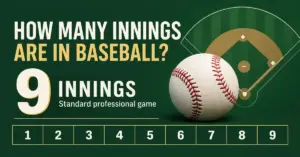
- Each team starts a nine-inning game with two challenges, and a team keeps a challenge when it wins (the call is overturned).
- Only the batter, catcher or pitcher may challenge, and they must do it almost immediately by tapping their head or helmet — no help from the dugout or bench, or the umpire can refuse it.
- In extra innings a team that has run out is granted one additional challenge per inning; a team with challenges still in hand gains nothing extra.
- Challenges are not available when a position player is pitching.
During 2025 big-league spring training, roughly 52% of challenges succeeded in overturning the call, a sign that the system is used for genuinely close pitches rather than obvious ones. Supporters hope it settles the handful of game-changing calls without slowing the game down or removing the human element; the review itself takes only a few seconds, which matters for anyone who follows how long a baseball game lasts.
The strike zone at other levels and in New Zealand
The same rulebook definition of the zone — midpoint of the torso down to the hollow of the knee, over the width of the plate — applies right across baseball, from Little League and local club grades in the Wellington region up to the professional game. What differs is the technology: the ABS challenge system is an MLB feature, so community, youth and senior games here still rely entirely on the home-plate umpire’s eye. That makes understanding the zone just as useful for a parent on the sideline or a batter learning plate discipline as it is for a television viewer. Fans who want to see the ABS system in action can check our guide on how to watch MLB in New Zealand.
Common misconceptions about the strike zone
- “The zone is a fixed size.” The width is fixed by the plate, but the height is personal to each batter and changes with their stance.
- “A pitch has to cross the centre of the plate.” Any part of the ball touching any part of the zone is a strike, including the edges.
- “A high strike is above the shoulders.” The top of the zone is the midpoint of the torso, well below the shoulders, so letter-high pitches are usually balls.
- “Robot umpires now call every pitch in MLB.” The 2026 ABS system only reviews pitches that are challenged; the human umpire still makes the original call on everything.
- “Any foul ball with two strikes is a strikeout.” Only a bunt fouled off with two strikes is; an ordinary foul keeps the at-bat alive.
Sources
- MLB.com — Official Information: The Strike Zone
- MLB.com — MLB announces ABS Challenge System for the 2026 season
- CBS Sports — MLB robot umpires: ABS challenge system approved for 2026
- Yahoo Sports — ABS challenge system coming to MLB in 2026: what you need to know
- Baseball-Reference — Glossary: Strike Zone
Vanliga frågor (FAQ)
Where exactly is the top and bottom of the strike zone?
The top is the midpoint between the top of the batter’s shoulders and the top of their uniform pants — roughly the middle of the torso. The bottom is the hollow just beneath the kneecap. Both are measured from the stance the batter takes as they prepare to swing, so the zone is personal to each hitter.
How wide is the strike zone?
The zone is as wide as home plate, which is 43 centimetres (17 inches) across its front edge. A pitch counts as a strike if any part of the ball passes through any part of that width, so pitches that only clip the corners still qualify.
Why do umpires call the same pitch differently?
Umpires judge a fast-moving pitch from a single angle in a fraction of a second, so the called zone tends to be an oval rather than a sharp box, with the corners most in doubt. Catcher framing, the batter’s stance and normal human variation all nudge borderline calls one way or the other.
What is the ABS challenge system?
ABS stands for Automated Ball-Strike system. From the 2026 Major League season, teams can challenge a ball or strike call and have Hawk-Eye cameras check the pitch against a defined electronic zone. Each team gets two challenges per nine-inning game, keeps them when correct, and only the batter, catcher or pitcher can trigger one by tapping their head.
Is a foul ball always a strike?
A foul ball is a strike when the batter has no strikes or one strike. With two strikes, an ordinary foul ball does not add a third strike, so a hitter can foul pitches off to stay alive. The exception is a bunt fouled off with two strikes, which is ruled a strikeout, and a foul tip caught by the catcher, which is a strike at any count.