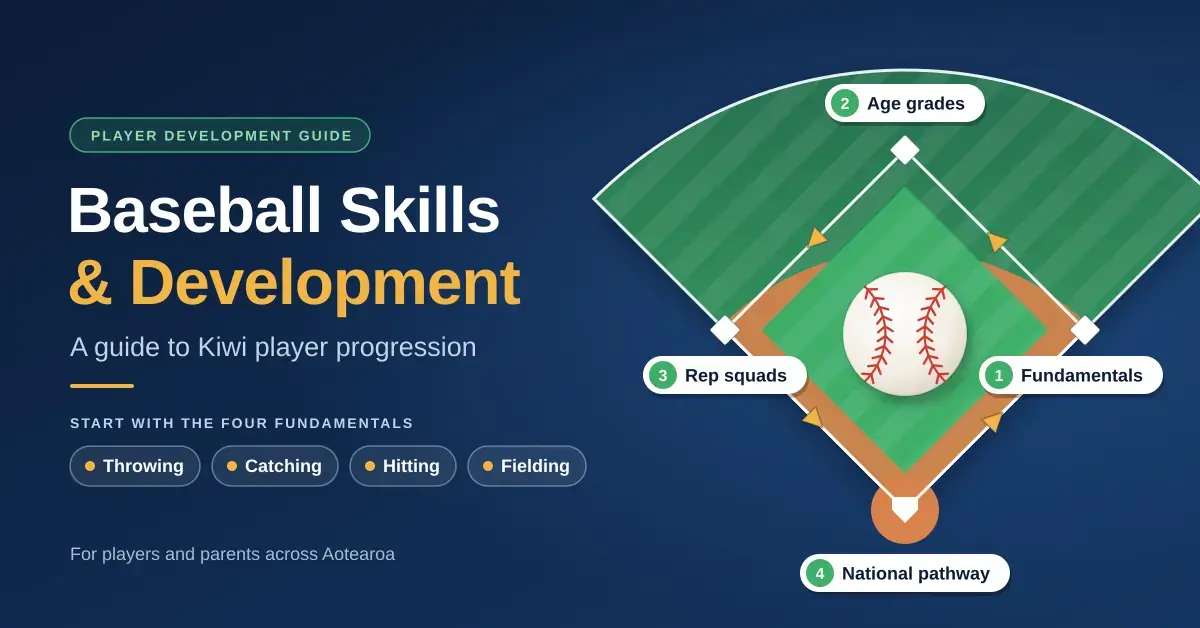
Baseball skill development in New Zealand follows a clear path: young players start with the fundamentals of throwing, catching, hitting and fielding, then progress through age-appropriate grades toward the national pathway run by Baseball New Zealand. This guide explains the core techniques a beginner needs, the drills that build them, how young pitchers stay safe, and how a Kiwi player can move from grassroots "Kiwi Ball" toward representative squads such as the Diamondblacks. It is written for players and parents in the Wellington region and across Aotearoa who want a practical, jargon-free roadmap.
Key Points
- Four fundamentals first: throwing, catching, hitting and fielding form the base of every player’s development.
- Technique before power: young players build grip, balance and command before chasing velocity or big swings.
- Arm safety matters: clubs follow MLB/USA Baseball Pitch Smart pitch-count and rest guidelines for youth pitchers.
- A clear national pathway: Baseball New Zealand links grassroots, identification and performance stages toward the Diamondblacks.
- Beginners welcome: Wellington Baseball Association clubs run introductory programmes using soft, reduced-injury balls.
Building foundational baseball skills in New Zealand
Every player starts with the same four building blocks: throwing, catching, hitting and fielding. For beginners, short, high-repetition sessions work best — a few focused minutes on each skill so technique improves before fatigue sets in. The first goal is simply enjoyment and confidence, which is why entry-level programmes use soft, reduced-injury balls and plenty of games rather than drills alone. Grip and body position come first, because habits formed early are the hardest to change later. Working through a set of structured youth baseball drills gives new players a repeatable way to practise.
The four-seam throwing grip
The four-seam grip is the most important throw to learn early because it produces the straightest, most predictable ball flight. The ball is held with the fingertips across the seams rather than buried in the palm, which reduces wobble and improves accuracy. A good throw steps directly toward the target, rotates the hips and shoulders together, and follows through fully to protect the arm. Regular, low-volume accuracy work matters more than raw arm strength at this stage — our guide to throwing accuracy covers this in more detail.
| Throwing component | Focus area | Developmental goal |
|---|---|---|
| Grip | Fingertips across the seams | Maximise rotation and flight stability |
| Stride | Step in line with the target | Accuracy and energy transfer |
| Arm path | High elbow and full extension | Reduce shoulder strain, add velocity |
Hitting progressions: from the tee to live pitching
Hitting is often called the hardest skill in sport because it combines hand-eye coordination with explosive rotation. Young hitters are taught a balanced stance with weight evenly distributed, eyes level, and the swing driven by the hips and core rather than the arms alone. A batting tee removes the moving ball so players can isolate their mechanics, then soft toss and live pitching gradually reintroduce timing. For a deeper look at technique, see our hitting tips.
Drills that build batting power
Once a hitter can make consistent contact, drills shift toward power and situational awareness. Power comes from the ground up — the legs and hips — not from swinging harder with the arms.
- Tee work: isolates the swing plane and fixes looping hand paths.
- Soft toss: builds timing and barrel control with a controlled underhand feed.
- Situational batting practice: rehearses real scenarios such as hitting behind a runner or working a full count.
- Video review: slow-motion replay helps spot energy "leaks" during the load and stride.
Fielding: infield and outfield skills
Defence splits into the quick reactions of the infield and the tracking and range of the outfield. Infielders use "alligator hands" — the glove as the bottom jaw, the throwing hand as the top — to secure ground balls out in front of the body while staying low. Outfielders work on the drop step and lateral tracking so they can read fly balls early, which matters at Wellington grounds where wind is a real factor. Clear communication ties it together: fielders call loudly for the ball to avoid collisions.
Developing soft hands
"Soft hands" means giving with the ball on contact so it settles cleanly into the glove. Short-hop and rapid-fire drills develop this along with a fast, reliable transfer to the throwing hand.
- Alligator hands: two hands secure the ball and speed up the transfer.
- Pop-fly priority calls: simple rules decide who takes a ball between players.
- Relay throws: the turn-and-throw needed for long outfield-to-home plays.
- Grounder progression: start with slow rollers, then add pace and unpredictable hops.
Pitching: mechanics and arm care
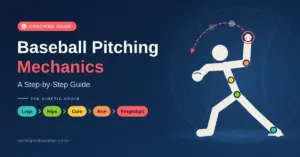
Pitching development in New Zealand is built around safety as much as skill. Youth arms are still growing, so clubs follow the MLB and USA Baseball Pitch Smart guidelines, which set age-based pitch-count limits and required rest days to reduce overuse injuries — the leading cause of arm problems in young pitchers. Sound mechanics start with a balanced knee lift, a strong drive off the rubber, and a consistent, repeatable arm slot. Our pitching mechanics guide breaks the delivery down step by step.
| Phase | Key mechanic | Benefit |
|---|---|---|
| Windup | Balanced stance and knee lift | Repeatable, consistent delivery |
| Drive | Push off the rubber | Generates ground force and velocity |
| Release | Consistent arm slot | Better strike-zone command |
Accuracy before velocity for young pitchers
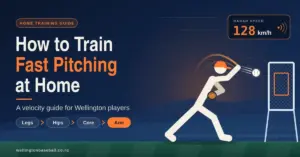
For pre-teens, command of the strike zone matters far more than raw speed. Simple target work in the bullpen — aiming at buckets or marked spots — builds control that serves a player for years, while chasing early velocity can encourage risky mechanics. Players wanting to practise between sessions can find ideas in our guide to training pitching at home.
Baserunning and speed
In lower-scoring junior grades, smart baserunning often decides games. Players learn to run through first base into foul territory, to round the bases on a tight inside line, and — in older grades — to read the pitcher for stolen bases. Agility-ladder work and short shuttle sprints develop the first-step quickness that turns a single into a double.
- Run through first: never slow down before the bag.
- Tagging up: know when to hold and when to advance on a caught fly ball.
- Sliding: practise safe, low slides, especially on damp grass.
- Coach signals: read the visual signs to stop, slide or advance.
The Baseball New Zealand player pathway
Baseball New Zealand runs a national player pathway that gives athletes a structured route from grassroots to representative honours. It begins in the community — local clubs, Little League and regional activity — where the focus is participation and enjoyment. National events such as the Summer Showdown, Little League All-Stars and Club Classic then give players a stage to be seen by national coaches. From there, regional hub training and the National Development Camp deepen baseball-specific skills, strength and conditioning, mental skills and nutrition, with the strongest players earning selection to the U15 Junior Diamondblacks, U18, U23 and the Men’s Diamondblacks. In the Wellington region, the youth community baseball scene is the first rung on this ladder.
Player Pathway Stages
| Stage | Focus | Typical settings |
|---|---|---|
| Participation | Learn the game and stay involved | Local clubs, Little League, Kiwi Ball |
| Identification | Be observed and selected | National tournaments, National Development Camp |
| Performance | Targeted, monitored training | Regional hubs, U15/U18/U23 and Diamondblacks squads |
From development to performance
The pathway broadly moves through three stages: participation (learning the game and staying involved), identification (being observed at national tournaments and camps), and performance (targeted, monitored training with elite coaching). To be considered for a national squad, players generally need to be seen in a national tournament environment. The Diamondblacks are the senior national side and represent New Zealand at World Baseball Softball Confederation (WBSC) events and qualifiers.
Coaching, strength and mindset
Good coaching underpins everything. Baseball New Zealand encourages a constraints-based approach, where coaches adjust the rules or space of a drill so players solve problems for themselves rather than simply following instructions. Alongside on-field skills, players build core stability and mobility — planks, medicine-ball work and resistance-band shoulder exercises — which support both a stable swing and a healthy throwing arm. Because baseball is a game of frequent failure, mental skills such as routine, breathing and visualisation are taught early to help players reset after a strikeout or an error.
Getting started and common mistakes
You do not need any experience to begin. Clubs affiliated with the Wellington Baseball Association run introductory programmes for absolute beginners, using soft balls and small-sided games. Before a first session it helps to know what to expect and to arrive with the right basics — see our overview of a first baseball practice and our safety tips for kids in Wellington. Common mistakes to avoid include specialising in one position too early, chasing pitching velocity before command, gripping the ball in the palm, and rounding the bases too wide.
- Right footwear: moulded plastic cleats or rubber-soled turf shoes suit most junior grass fields; metal spikes are generally not used at junior level.
- Balanced practice: share time across throwing, hitting and fielding rather than only batting.
- Rest and recovery: follow pitch-count and rest guidance to protect growing arms.
For a broad overview of how baseball fits within the wider world of sport, you can browse the outline of sports on Wikipedia.
Reference sources
Frequently Asked Questions
What are the core baseball skills for beginners in New Zealand?
The four fundamentals are throwing (grip and mechanics), catching (tracking and hand position), hitting (stance and contact), and fielding (ready position and ground balls). Beginners usually learn these with soft, reduced-injury balls before moving to hardball.
How can young players improve their batting power?
Power comes from the legs and hips, not the arms. Tee work fixes the swing path, soft toss builds timing, and rotational core exercises add force — so the whole body drives through the ball rather than just the hands.
What is the Baseball New Zealand player pathway?
It is a structured route from grassroots baseball to national teams. Players are identified at national tournaments and camps, developed through regional hubs, and the best earn selection to the U15, U18, U23 or Men’s Diamondblacks squads.
Are there safety rules for youth pitchers?
Yes. Clubs follow the MLB and USA Baseball Pitch Smart guidelines, which set age-based pitch-count limits and required rest days between outings to reduce the overuse injuries that most commonly affect young arms.
Can I start baseball if I have never played before?
Absolutely. Clubs affiliated with the Wellington Baseball Association run beginner programmes designed to teach the basic motor skills of catching, throwing and hitting in a safe, supervised setting for all ages.