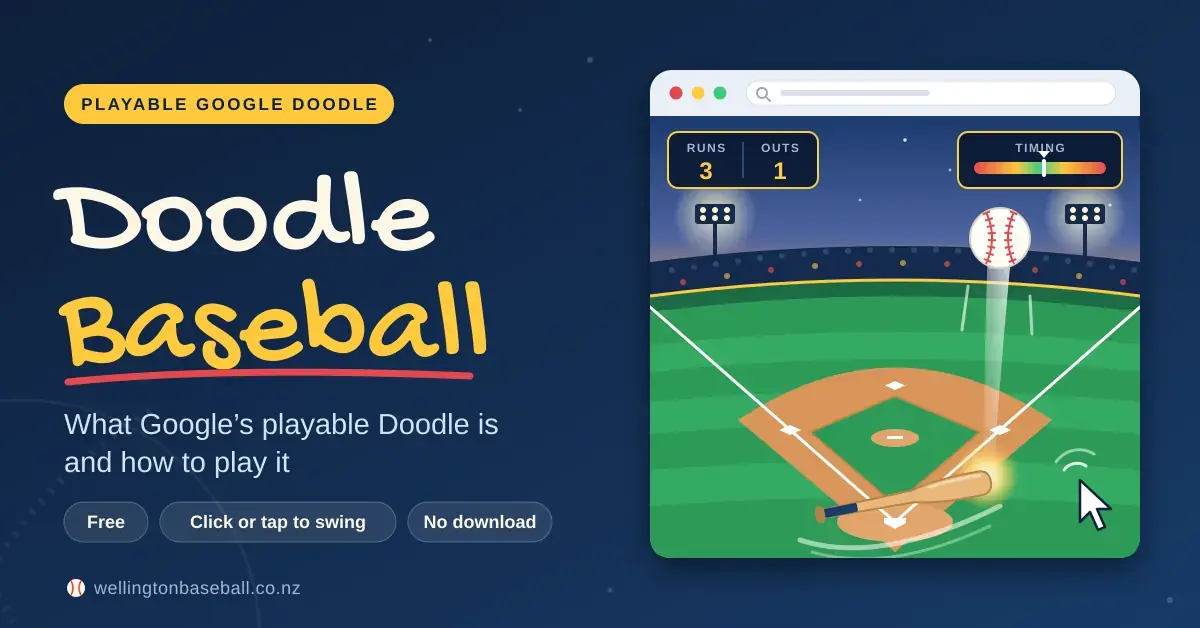
Doodle Baseball is the free, playable Google Doodle that first appeared on Google’s homepage for the United States’ Fourth of July in 2019. Instead of a static logo, Google built a short browser game in which cartoon ballpark snacks step up to bat against a team of pitching peanuts — you simply click or tap to swing. It has since become one of the most replayed interactive Doodles, and for a lot of people in New Zealand it is the first time they ever “play” baseball at all. This guide explains what the game actually is, how it works, where to find the genuine version, and how the timing it teaches connects to the real sport played at clubs around Wellington.
Quick Facts
| Game | Doodle Baseball (Fourth of July 2019 interactive Google Doodle) |
|---|---|
| Developer | |
| Released | 4 July 2019 |
| Type | Playable browser game (HTML5) — no download or plugin |
| Devices | Desktop, tablet and mobile browsers |
| Players | Single-player, batting against the computer |
| Cost | Free |
| Where to play | Official Google Doodle archive |
What Is Doodle Baseball?
A “Google Doodle” is the decorated version of the Google logo that the company places on its homepage to mark holidays, events and notable people. Most Doodles are simply artwork, but a handful are interactive mini-games you can play in the browser. Doodle Baseball is one of these playable Doodles.
It launched on 4 July 2019 to celebrate United States Independence Day, built around a “backyard BBQ” theme in which classic American summertime snacks take their turn at the plate. It is a Google art-and-engineering project, not an official product of Major League Baseball or any league — so it is a light-hearted cartoon version of the game rather than a true simulation. If you want to understand where the real sport came from, our explainer on who invented baseball covers the history the Doodle only hints at.
How to Play Doodle Baseball
The controls are deliberately simple, which is a big part of why the game spread so widely. You only ever do one thing: swing the bat with good timing.
- Open the game. Load the Doodle in any web browser (the official link is in the Quick Facts box above). No account, app or download is needed.
- Start the at-bat. Press the play or bat button to send your food character to the plate.
- Swing. Click the mouse or tap the screen as the ball reaches you. There is no aiming or movement — timing is everything.
- Keep your at-bat alive. Miss-timed swings count as strikes. Three strikes ends the game.
- Chase a high score. There is no set finish line; the aim is to bat for as long as you can and score as many runs as possible. The pitching gets faster and trickier the longer you survive.
Because the whole game lives or dies on your reaction to a single moving target, it quietly rewards the same hand-eye timing that real hitters train for. If that side of the game appeals to you, our guide to the top hitting tips for baseball players explains how timing, stance and pitch recognition work with a real bat.
Reading the Peanut Pitcher
The peanuts do more than throw straight. In the game, the pitching peanut’s hat changes colour before each delivery, and the colour tells you how the ball will behave. Learning the colours is the single biggest step toward a long innings.
| Hat colour | What the pitch does | How to handle it |
|---|---|---|
| White | Straight, steady, normal speed | The standard pitch — swing as the ball reaches the plate |
| Blue | Travels in a high rainbow arc | Wait for the ball to drop back into the zone before swinging |
| Purple | Flies straight but disappears on the way in | Judge the speed early and swing on timing, not sight |
| Yellow | Fast, zig-zagging path | Stay calm and react late — don’t chase the wobble |
| Green | Spins in toward you | Track the ball’s centre and swing through it |
| Red | Straight but much faster | Pure reaction — be ready the instant it leaves the hand |
Key Points
- Doodle Baseball is a free, browser-based Google Doodle game — not an official MLB product.
- You control food characters batting against pitching peanuts; one click or tap swings the bat.
- The peanut pitcher’s hat colour signals the pitch, so learning the colours is the key to a high score.
- Three strikes end the game; there is no set finish, just your best score.
- Its timing is a fun first taste of baseball, but the real sport adds fielding, running and teamwork.
The Food Characters and the BBQ Theme
The charm of Doodle Baseball comes from its roster of personified picnic food. Google built the game around eight collectible characters you can “collect” as you play, each styled like a baseball trading card:
- H-Dog — a hot dog
- Triple — a hamburger
- Wild Slice — a slice of pizza
- The Cobbra — corn on the cob
- 2 Scoops — ice cream
- The Sauce — a ketchup bottle
- Big Red — watermelon
- Sluggin’ Sirloin — a steak
On the other side of the diamond, a team of peanuts handles the pitching and fielding. The cookout styling is distinctly American and tied to the Fourth of July, but the appeal travels well: the game needs no knowledge of the rulebook, no favourite team and no language beyond “swing when the ball arrives.”
Why Doodle Baseball Became So Popular
Doodle Baseball is a good case study in low-friction design. A few honest reasons explain its reach:
- It is free and instant. It runs in the browser with no sign-in, install or payment.
- One input. A single click or tap keeps it playable for young children and casual players alike.
- It works almost anywhere. As a lightweight web game it runs on most phones, tablets and computers without special hardware.
- It is short and repeatable. A round lasts a minute or two, which suits quick breaks and “one more go” replays.
- It carries Google’s reach. Appearing on the world’s most-visited homepage put it in front of an enormous audience on launch day, and it has stayed easy to find since.
From the Screen to the Real Diamond
For a New Zealand reader, the interesting question is what a cartoon clicker has to do with the real game. The honest answer is: a little, and in a useful way. Doodle Baseball introduces the core idea that batting is about timing a moving ball, and it does so without the pressure of a full field, a hard ball or a scoreboard. That can lower the barrier for a curious child before they ever visit a club.
What the game cannot teach is almost everything else — fielding, throwing, base running, positioning and teamwork — because it handles all of that automatically. Moving from the screen to the grass means swapping a single click for a full-body swing and learning to read a three-dimensional field. If a game sparks interest in your household, the practical next steps are covered in our guides on how to get your child into baseball in New Zealand and the wider world of youth and community baseball in Wellington. For the rules themselves, see our plain-English walkthrough of how to play baseball.
The broader point — that games, apps and social media can raise the profile of a minority sport — is one we explore separately in our feature on whether social media and video games have raised baseball’s profile in New Zealand.
What the Game Teaches vs What It Leaves Out
This comparison shows where the digital version lines up with the real sport and where it simply fills in the gaps for you.
| In Doodle Baseball | In real baseball | The main difference |
|---|---|---|
| One click or tap to swing | A full swing using legs, hips and hands | Real hitting is a whole-body movement, not a button press |
| Fixed, front-on view of the pitch | Tracking the ball with depth and angle | You judge distance and speed in three dimensions |
| Base running happens automatically | You sprint, turn and slide yourself | Running and sliding are physical skills of their own |
| Fielding is done by the computer | Nine players cover the field together | Defence and teamwork are central to the real game |
Common Mistakes and Tips for a Higher Score
Most players stall early for the same reasons. A few adjustments go a long way:
- Watch the hat, not the ball. The pitcher’s hat colour warns you what is coming before the ball moves.
- Don’t swing too early. On arcing (blue) and slow pitches, wait for the ball to arrive rather than reacting to its launch.
- Stay relaxed. Panic-clicking burns strikes; one well-timed swing beats three rushed ones.
- Expect the speed to climb. The longer you last, the faster and more erratic the pitching becomes — treat the red (fast) pitch as a pure reaction test.
- Use the version you can control. On a desktop, a mouse click is often easier to time precisely than a trackpad tap.
Is Doodle Baseball Safe and Free?
The genuine Doodle Baseball is free, needs no download and asks for no personal details to play — it is hosted by Google in its official Doodle archive. Because the game is popular, many third-party websites host copies or clones, sometimes wrapped in heavy advertising or asking you to install something. There is no need for any of that: stick to the official archive link in the Quick Facts box above, and treat sites that demand downloads, logins or payment to “unlock” the game with caution.
Sources
Frequently Asked Questions
What is Doodle Baseball?
Doodle Baseball is a free, interactive Google Doodle game first published on 4 July 2019 to mark United States Independence Day. You control food-themed characters batting against a team of pitching peanuts, and you swing with a single click or tap. It is a casual browser game made by Google, not an official product of any baseball league.
How do you play Doodle Baseball?
Open the Doodle in a web browser, press the play button to send your character to bat, then click or tap to swing as the ball reaches the plate. Timing is the only skill the game tests. Three mistimed swings count as strikes and end the game, so the goal is to time each pitch and score as many runs as you can.
Is Doodle Baseball free, and do I need to download it?
Yes, it is free, and no download is required. The genuine version runs directly in your browser through Google’s official Doodle archive, on both computers and mobile devices, with no sign-in or payment. Be wary of unofficial copies that ask you to install software or log in.
Does the game ever end?
There is no fixed ending or final level. The game continues until you record three strikes, and the pitching gets faster and harder the longer you bat. The only real goal is to beat your previous high score.
Does Doodle Baseball teach real baseball skills?
It helps a little with batting timing and hand-eye coordination, which are genuine parts of hitting. It does not teach fielding, throwing, base running or teamwork, because the game handles those automatically. Think of it as a fun first taste of the sport rather than training — the real skills are learned at a club.