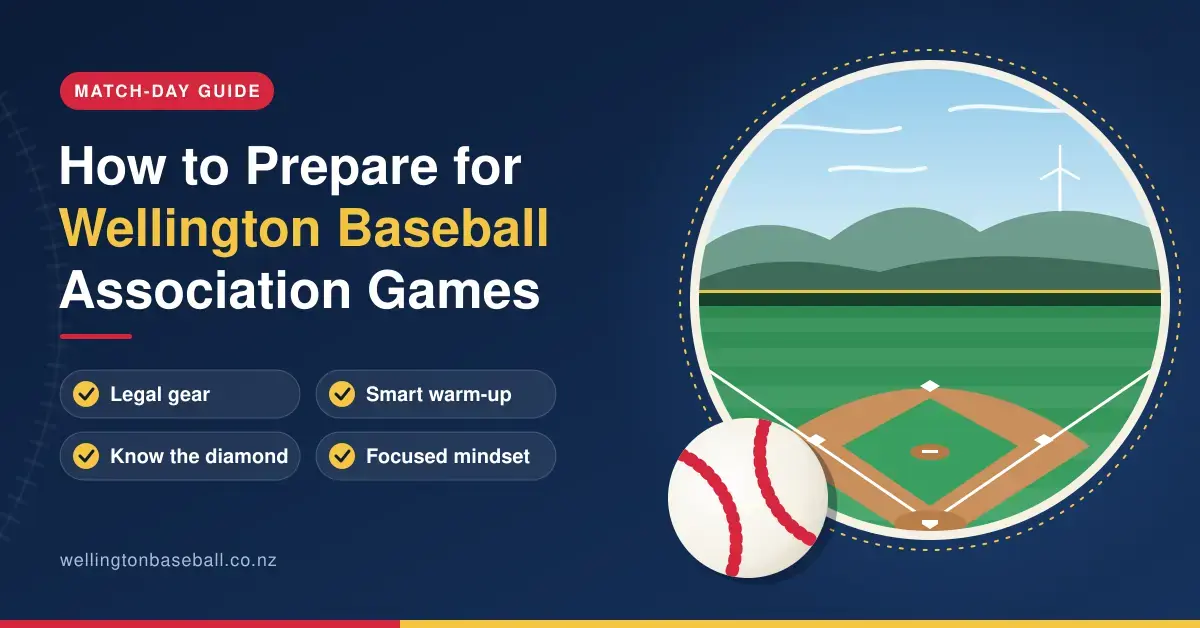
Getting ready for a Wellington Baseball Association (WBA) game involves more than turning up with a glove. Sound preparation combines legal, well-fitted equipment, a sensible warm-up, an awareness of the diamond you are playing on, and a calm, focused mindset. The WBA is the regional body for baseball in the greater Wellington area, sitting under the national governing body, Baseball New Zealand, and above local clubs such as the Wellington City Pirates and Hutt Valley Hornets. This guide walks players, parents and new coaches through a clear match-day routine, from KiwiBall (the entry-level T-Ball programme) through to senior grades, and explains the rules and standards that apply so you arrive ready to play.
Key Points
- Check your gear is legal: NOCSAE-stamped helmets and catcher’s masks, unaltered, plus a grade-appropriate bat (USABat or BBCOR).
- Warm up gradually: build the throwing arm over weeks, and allow 45–60 minutes on match day.
- Know your grade: KiwiBall/T-Ball through to senior grades each have their own bat, cleat and safety rules.
- Read the diamond: assess grass, wind and fences before the first pitch.
- Fuel and hydrate: eat 2–3 hours before, sip water throughout, and recover afterwards.
- Stay informed: follow your club on Sporty for schedules and postponements.
How Wellington baseball is organised
Baseball in New Zealand is a summer sport, with the Wellington season running roughly from November to March and a break over the Christmas period. Grades progress from KiwiBall and T-Ball for the youngest players, through 10U and 12U (played under Little League rules), on to Junior (13U and above) and senior or open men’s grades. Much of the region’s competitive play happens in the Wellington Travel League, with fixtures typically on Sundays at venues including Ian Galloway Park in Northland. Many players are first introduced to the game through school and community programmes (Wiki) before joining a club.
Knowing your grade matters because it determines the rules and equipment that apply to you. If you are still choosing where to play, our overview of Wellington clubs and teams and the local schedules and fixtures are useful starting points.
Getting your equipment game-ready
The first step in preparation is making sure your gear is safe, compliant and in working order. Batting helmets and catcher’s masks must meet the NOCSAE standard (the certification set by the National Operating Committee on Standards for Athletic Equipment) and carry the NOCSAE stamp. Adding stickers, decals or paint can void that certification and make a helmet illegal for play, so keep protective gear in its original condition. Many clubs keep shared gear bags with bats and catcher’s equipment, but most regular players eventually build their own kit.
Matching gear to your grade
Bat and footwear rules change as players move up the grades. Gloves should be properly broken in so the ball transfers cleanly from pocket to throwing hand, and a bat should be sized to the player rather than simply borrowed. The table below summarises the main equipment standards; for more on protective kit, see our guide to baseball safety for kids in Wellington.
| Grade (approx. age) | Bat standard | Cleats | Key safety gear |
|---|---|---|---|
| KiwiBall / T-Ball (~4–8) | Tee and soft/safety balls | Molded only | NOCSAE batting helmet |
| 10U–12U (Major and below) | USABat stamp required | Molded only | NOCSAE helmet; catcher cup and throat guard |
| 13U / Junior | USABat or BBCOR | Molded or metal | NOCSAE helmet; full catcher kit |
| Senior / Open | BBCOR | Molded or metal | NOCSAE helmet; full catcher kit |
A few points are often misunderstood. Metal spikes are not permitted at 12U (Major) and below, but are allowed from 13U upwards. A protective cup is mandatory for catchers and strongly recommended for other players. On jewellery, Little League removed its blanket ban in 2025, so items are generally allowed unless an umpire judges them a safety hazard; medical-alert jewellery is always permitted. Because local leagues can add their own conditions, confirm the current rules with your club before the season starts.
Building baseball fitness
After the off-season, players need to ease back into ‘baseball shape’ to avoid common arm and shoulder complaints. Throwing is the most demanding part of the game, so build arm strength gradually over several weeks rather than firing at full velocity from day one. A strong core and mobile legs help generate power in the swing and quickness on the bases.
Simple pre-season routines
- Shoulder care: resistance-band work for the rotator cuff and the muscles that stabilise the shoulder blade.
- Dynamic warm-up: high knees, heel flicks and torso rotations to prime the body before activity.
- Short sprints: repeated 15–20 metre bursts to sharpen first-step speed out of the box.
- Throwing progression: start short and lengthen the distance, keeping accuracy the priority; our tips on throwing accuracy go into more detail.
The pre-game hour: a 60-minute warm-up
Teams usually gather 45 to 60 minutes before the scheduled first pitch. A consistent routine settles nerves and moves players smoothly from general warm-up into game-specific work. Coaches often use this window to finalise the line-up and assign roles such as scoring.
| Time before first pitch | Activity | Focus |
|---|---|---|
| 60–45 min | Team talk and dynamic stretching | Loosen up and set the plan |
| 45–30 min | Throwing progression | Accuracy, building to game distance |
| 30–15 min | Batting practice (if available) | Timing and situational hitting |
| 15–5 min | Infield/outfield practice | Reading grass speed and wind |
| 5–0 min | Dugout transition | Final gear check and hydration |
Reading the field before you play
Wellington grounds vary, and a quick ‘field walk’ can give you a practical edge. Longer grass slows ground balls; a wet or uneven infield produces bad hops; and the capital’s wind can move fly balls noticeably. Check the surface for soft or rough patches, note the wind direction, look at how much foul territory there is near stands or bullpens, and see how the outfield fence behaves — chain-link tends to deaden a carom, while solid or padded walls rebound further.
The battery: catcher and pitcher preparation
The pitcher and catcher — together known as the ‘battery’ — need time to sync up before the first inning. A catcher should spend around 10 to 15 minutes receiving the starting pitcher in the bullpen, learning which pitches are working that day and confirming signs. Warm-up should include receiving, quick transfers and blocking balls in the dirt. Full protective gear, including a mask with a throat guard, a chest protector and shin guards, is required whenever a catcher is receiving. For a deeper look at the role, see our guide to the catcher in baseball.
Batting practice with a purpose
Where cages or field time allow, pre-game hitting is a chance to calibrate timing rather than swing for the fences. Prepared hitters rehearse the situations they expect to face in the game.
- Bunts: a couple of controlled bunts down the first- or third-base line to feel the barrel.
- Opposite field: drive the ball into the gap the other way.
- Hit and run: make contact and keep the ball on the ground.
- Get the runner in: elevate for a sacrifice fly or hit a firm line drive.
Defensive routines for infield and outfield
Fielding preparation in Wellington often means adjusting to grass hops and coastal wind. Infielders should take short-hop grounders on the edge of the grass to sharpen reflexes and quick feet. Outfielders should practise the drop step so they can turn and run without losing the ball, and track a few flies to gauge the wind and sun. Agreeing cut-off responsibilities and calling loudly for catches prevents collisions once the game starts.
Fuelling and hydration
Games can run long, and players sweat even in cooler weather, so steady fluids and sensible food matter. Bring a labelled water bottle and avoid heavy, greasy meals right before play. The table below is a simple guide.
| Timing | Goal | Examples |
|---|---|---|
| 2–3 hours before | Energy loading | Porridge, pasta, or chicken and rice |
| ~30 min before | Top-up | Banana or a light snack |
| During the game | Maintenance | Water; electrolytes on hot days |
| After the game | Recovery | Protein with carbohydrate, plus fluids |
Mental preparation and sportsmanship
Baseball involves frequent failure, so a steady mindset is part of preparation. In youth grades the emphasis is on effort, learning and respect rather than statistics. A short, repeatable pre-game routine — a few deep breaths, a simple visualisation, or a set warm-up order — helps players settle. Treat umpires and opponents with respect, take responsibility for your own gear and uniform, and focus on the next play rather than dwelling on mistakes.
Rain, postponements and staying informed
Wellington weather can force late changes. Postponement decisions are generally made by the regional association or the host club and communicated through team apps and social media. Many New Zealand clubs, including Wellington baseball teams, run their websites and notifications on the Sporty platform, so make sure your notifications are switched on. Some teams also use scoring apps such as GameChanger, though scorekeeping tools vary by club. Pitchers should also track their recent workload: Major League Baseball and USA Baseball’s Pitch Smart programme sets age-based pitch-count limits and required rest days to protect young arms.
Game-Day Kit Checklist
- Broken-in glove (and position-specific mitt if you catch or play first base)
- Grade-legal bat with the correct stamp (USABat or BBCOR)
- NOCSAE-stamped batting helmet, free of stickers or paint
- Team uniform, cap and appropriate cleats (molded for 12U and below)
- Protective cup (mandatory for catchers) and full catcher’s gear if applicable
- Labelled water bottle and simple snacks
- Sunscreen, a light layer for Wellington wind, and a spare pair of socks
Sources
- Baseball New Zealand — national governing body
- Wellington Baseball Association
- Little League — bat information (USABat/BBCOR)
- Little League — metal cleats rule
- Little League — 2025 rulebook changes (jewellery)
- NOCSAE — baseball and softball standards
- MLB Pitch Smart — pitching guidelines
- Sporty — New Zealand club platform
Frequently Asked Questions (FAQ)
What equipment is mandatory for a WBA game?
Every player needs a glove, and batting helmets and catcher’s gear must meet the NOCSAE standard. Catchers must wear a protective cup and a mask with a throat guard; a cup is strongly recommended for other players. Bat and cleat rules depend on your grade.
Are metal cleats allowed in Wellington baseball?
Metal spikes are not permitted at 12U (Major) and below, where molded cleats are required. Metal cleats are allowed from 13U (Junior) upwards. Check your club’s rules if you are unsure of your grade.
How long should a pre-game warm-up take?
Most teams allow 45 to 60 minutes, moving from a team talk and dynamic stretching through a throwing progression, then batting and infield/outfield practice, before a final gear check in the dugout.
Can players wear jewellery during a game?
Little League removed its blanket jewellery ban in 2025, so jewellery is generally allowed unless an umpire judges it a safety hazard. Medical-alert jewellery is always permitted, and individual leagues may set stricter conditions.
What happens if it rains before a game?
Postponement calls are usually made by the regional association or host club and shared through team apps and social media. Because many New Zealand clubs use the Sporty platform, keeping your notifications on is the reliable way to hear of changes.