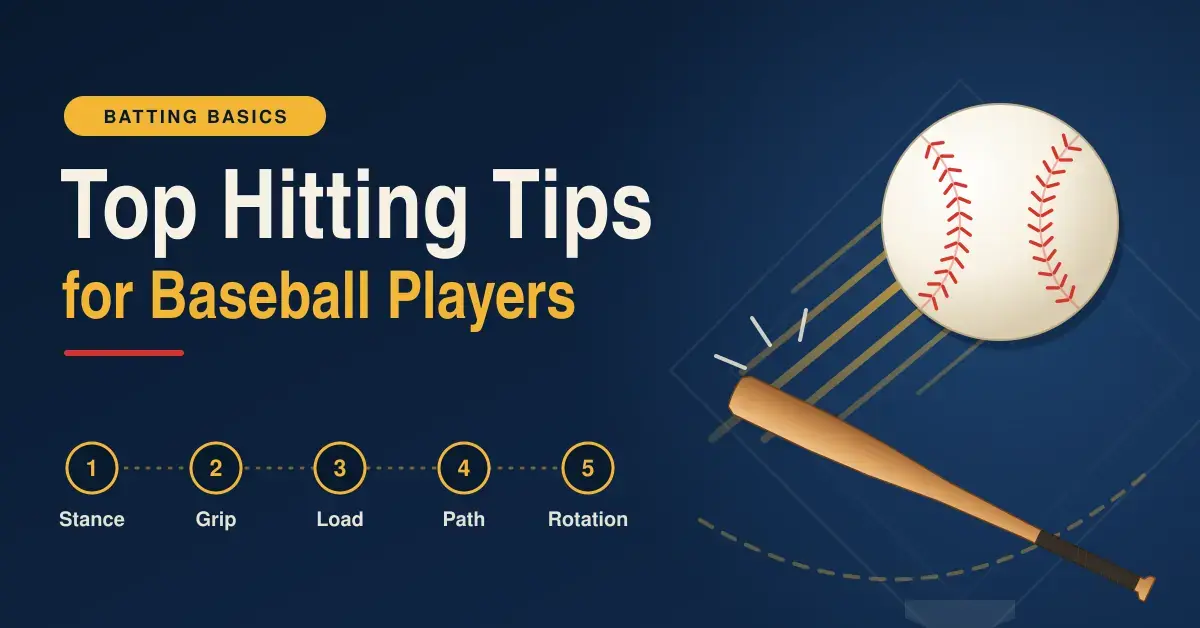
Learning to hit a baseball well is one of the hardest skills in sport, and it rewards patience far more than brute strength. A repeatable swing comes from stacking a few fundamentals in the right order: a balanced stance, a relaxed grip, a controlled load, a short path to the ball and explosive rotation from the hips. This guide breaks those fundamentals down in plain language for players across the Wellington region and the rest of New Zealand — whether you are a junior just off the batting tee or a senior facing live pitching in the Wellington Baseball Association. Work through each piece in order, and the swing starts to feel simple.
Key Points
- Foundation first: build a balanced, shoulder-width stance with level eyes to track the pitch cleanly.
- Grip dynamics: align the “knocker knuckles” and hold the bat in the fingers for a faster, freer barrel.
- The load: shift weight subtly onto the back hip to store energy before the stride.
- Short to long: keep a compact hand path to the ball, then extend fully through it.
- Plate discipline: know your strike zone and swing only at pitches you can drive.
Establishing an Athletic, Balanced Batting Stance
Every reliable swing starts from a stable base. Set your feet slightly wider than shoulder-width, bend the knees into an athletic “ready” position, and keep your weight on the balls of your feet rather than the heels. In a windy city like Wellington, a wide base is even more important because it keeps your head still — and a still head gives your eyes a stable platform to track the pitch. A common beginner mistake is standing tall and stiff, which slows the hips and makes it hard to catch up to faster pitching. Keep your eyes level and your front shoulder tucked slightly toward the plate so you don’t “open up” too early.
Key Checkpoints for Your Setup
A consistent setup is what makes your mechanics repeatable under game-day pressure.
- Feet alignment: keep your feet parallel, or turn the front foot in very slightly.
- Hand height: hold the bat near shoulder height, roughly 15–25 cm from your back ear.
- Shoulder level: tuck the front shoulder in toward the plate to stay closed a beat longer.
- Weight ratio: start at about 50/50, or slightly back-leg biased (around 60/40).
| Stance component | Ideal form | Common error |
|---|---|---|
| Feet | Shoulder-width or a touch wider | Too narrow, losing balance |
| Knees | Soft, athletic flex | Standing tall, slow to react |
| Hands | Relaxed near the back shoulder | “White-knuckling” or held too high |
| Eyes | Level and focused on release | Tilted head, distorted vision |
Mastering the Grip and “Knocker Knuckle” Alignment
How you hold the bat directly affects how freely the barrel moves through the strike zone. A popular cue is to line up the “knocker knuckles” — the middle knuckles you would use to knock on a door — on both hands. This alignment keeps the wrists loose and stops the forearms from locking up. Hold the bat in the fingers rather than buried in the palms, which lets the wrists “whip” the barrel through contact. Bat speed like this matters most for younger players using light metal bats, where hand speed is the main driver of how hard the ball comes off the barrel. If any of the terminology here is new, our glossary of baseball terms is a handy reference.
Enhancing Bat Control and Speed
A relaxed grip is a fast grip; tension in the hands travels up the arms and slows the whole rotation.
- Finger placement: wrap the fingers around the handle and keep the top index finger slightly loose.
- Pressure level: hold the bat like a small bird — firm enough to control, gentle enough not to crush it.
- Alignment: check that your middle knuckles form a roughly straight line along the handle.
- Wrist snap: practise “flicking” the bat through the zone to feel how much a finger grip helps.
The Load and Stride: Storing Potential Energy
The “load” is the small move that coils the swing like a spring. As the pitcher begins their windup, shift your weight onto the inside of your back foot and draw the hands back a touch. This creates hip-shoulder separation — the gap between where your hips point and where your hands and shoulders stay — which is the main source of power in the swing. The stride that follows should be a soft step toward the pitcher, with the weight staying back until the front foot lands. Remember: the stride is for timing, not power. The power comes from the rotation that happens after the foot plants.
Refining Timing and Separation
Getting the transition from load to stride smooth is what separates good hitters from great ones.
- Internal rotation: feel the back hip “buckle” slightly as you load into the glute.
- Hand separation: move the hands 5–10 cm back as the front foot moves forward.
- Soft landing: land on the ball of the front foot to keep a stacked, balanced posture.
- Rhythm: begin your load as the pitcher’s arm reaches its highest point to stay in sync.
| Swing phase | Goal | Key mechanic |
|---|---|---|
| The load | Gather energy | Weight shifts to the back hip |
| The stride | Timing | Soft, direct step toward the pitcher |
| The separation | Create torque | Hands stay back as the hips start forward |
| The launch | Release energy | Aggressive hip rotation |
Achieving a Short, Compact Swing Path
“Staying inside the ball” is a hallmark of high-average hitters. A compact path keeps the hands close to the body on the way to the ball instead of “casting” the barrel out wide. Picture a direct line from your back shoulder to the point of contact — the shorter that line, the more time you have to decide whether to swing. A useful cue is to drive the hands toward the ball while the barrel levels out through the zone, which produces a slight upward launch angle naturally. These paths are easiest to groove with structured repetition; our guide to baseball drills for youth players has plenty of tee and soft-toss work to try.
Drills for Barrel Control
Tools like the batting tee let you isolate the hand path without the pressure of a moving pitch.
- Fence drill: stand a bat’s length from a fence and swing — if the barrel clips the fence, your swing is too loopy.
- One-handed swings: use a short bat to feel the bottom-hand pull and top-hand drive separately.
- PVC-pipe swings: a light pipe lets you focus purely on the path and speed of the hands.
- Knob to ball: point the knob of the bat at the ball as you start down to keep the path tight.
Power Generation Through Hip Rotation and Core Engagement
Real hitting power comes from the ground up, not the arms down. As the front foot plants, the back hip should fire toward the pitcher, driving a kinetic chain in which energy from the legs travels through the core and out into the bat. That is why core work — medicine-ball throws, rotational planks — matters as much as batting practice for developing players. Without explosive hip rotation, a hitter falls back on “arm-swinging,” which produces weak fly balls and ground balls. If you also pitch, the same lower-half power principles apply; see our pitching mechanics guide for the throwing side of the kinetic chain.
Maximising Rotational Torque
Coaches use simple cues to help players feel the “snap” of the hips.
- Lead-hip clearance: the front hip opens up so the back hip can fire through.
- Core tension: keep the abdominal muscles firm to stop energy leaking during the turn.
- Firm front side: the front leg braces at contact to stop your forward momentum.
- Back-foot pivot: the back heel finishes pointing toward the sky.
Eye Discipline and Pitch Recognition
You can’t hit what you can’t see, so vision belongs near the top of any hitting checklist. From the moment the pitcher breaks their hands, keep a soft focus on the release point; as the ball leaves the hand, sharpen to a hard focus and read the spin to tell a fastball from a curveball or changeup. In Wellington’s breezy conditions a ball can move late, so track it all the way to the barrel. Building a clear mental map of your strike zone — the area over the plate roughly from mid-chest to the bottom of the knees — helps you lay off pitches out of the zone and force the pitcher to throw yours. For definitions of pitch types and counts, the Wiki glossary is a useful starting point.
Sharpening Your Hitting IQ
Discipline at the plate usually earns you better pitches to hit later in the count.
- The “window” concept: picture a small window over the plate — if the ball isn’t in it, don’t swing.
- Spin recognition: fastballs carry backspin, curveballs topspin; learn to see the difference early.
- Bunting for vision: practising bunts forces you to track the ball all the way to the bat.
- Two-strike approach: choke up and widen the stance to put contact ahead of power.
Situational Hitting: Going the Other Way and Bunting
A one-dimensional hitter is easy to defend. Versatile hitters know when to pull the ball and when to go the other way. To drive an outside pitch to the opposite field, let it travel deeper into the zone and hit through the ball to that side. Bunting is still a valuable “small ball” skill in New Zealand club baseball for moving runners or beating out a base hit. The more situations you can handle, the more valuable you become to any team — a theme we develop further in our overview of baseball skills development.
Offensive Versatility Tactics
Adapting your swing to the game situation is a hallmark of “baseball IQ.”
- Sacrifice bunt: square up and “catch” the ball with the barrel rather than jabbing at it.
- Hitting behind runners: drive the ball to the right side to move a runner from second to third.
- Deep contact point: practise hitting the inside half of the ball on the tee for opposite-field work.
- Hit and run: shorten the swing to guarantee contact when a runner is in motion.
| Strategy | Objective | Technical adjustment |
|---|---|---|
| Opposite field | Beat the defence | Let the ball travel deep in the zone |
| Sacrifice bunt | Move the runner | Angle the barrel, absorb the ball |
| Power pull | Drive in runs | Make contact out in front of the plate |
| Two-strike hit | Avoid the strikeout | Shorten up and choke up on the bat |
The Mental Game: Confidence and Handling Failure
Baseball is a game of failure — even elite hitters make an out roughly seven times out of ten, since a .300 average means succeeding only three times in ten. A resilient mindset is therefore one of the most important hitting skills. A consistent pre-at-bat routine, such as adjusting your batting gloves or taking one deliberate breath, tells your brain it’s time to compete. After a strikeout, “flush” the frustration and reset for the next play or at-bat. In New Zealand’s tight-knit baseball community, a positive, team-first attitude is noticed and valued by representative coaches.
Building a Resilient Mindset
Your internal dialogue shapes how you perform when the pressure is on.
- Positive visualisation: spend a few minutes a day picturing yourself driving a ball into the gap.
- Next-pitch mentality: treat every pitch as a fresh start; what happened before doesn’t matter.
- Body language: stand tall in the box to project confidence to the pitcher.
- Embrace the challenge: see a hard-throwing pitcher as a test of your skills, not a threat.
Off-Season Training: Building Strength and Bat Speed
Quick Facts
| Best practice volume | ~50–100 quality tee swings, 3–4 times per week |
| Main power source | Hip rotation and hip-shoulder separation (ground up) |
| Success benchmark | A .300 average still means an out ~7 times in 10 |
| Strike zone | Over the plate, roughly mid-chest to the bottom of the knees |
| Off-season focus | Rotational strength, bat-speed work and indoor cage reps |
In New Zealand, the cooler winter months are the ideal time to build the strength that shows up as bat speed in summer. Rotational work — weighted medicine-ball throws, deadlifts and cable rotations — transfers directly to how hard you hit the ball. “Overload/underload” training, using bats slightly heavier or lighter than your game bat, can also train the nervous system to move faster. Wellington’s indoor batting cages let you get high-repetition work in without losing sessions to rain or cold. Just as importantly, make sure your gear fits — our guide to choosing a baseball bat covers length and weight for younger players. Bat sensors and swing trackers, part of the wider field of sports Wikipedia describes as sports analytics, can give you objective feedback on that progress.
A Year-Round Development Plan
Consistency in the off-season leads to strong form when the season starts.
- Medicine-ball slams: 3 sets of 10 to build explosive core power.
- Weighted bat swings: a short daily set with a heavier bat to build forearm strength.
- Swing-speed tracking: use a sensor to monitor bat speed over time.
- Plyometrics: box jumps improve the ground force behind your stride.
| Winter focus | Goal | Tools |
|---|---|---|
| Strength | Physical power base | Free weights and bands |
| Bat speed | Velocity | Light and heavy training bats |
| Mechanics | Repeatability | Batting tee and mirror |
| Conditioning | Endurance | Sprints and an agility ladder |
Bringing It All Together
Better hitting is the sum of small, deliberate gains rather than one magic fix. Prioritise a balanced stance, a compact hand path and explosive hip rotation, and the mechanical foundation takes care of itself. Then remember that hitting is as much mental as physical: staying disciplined, reading pitches early and keeping your confidence through the inevitable slumps are the traits that define a dependable hitter. Whether you are training in a backyard in Lower Hutt or stepping up on a national stage, the essentials don’t change — eyes on the ball, hips through the zone, and a short memory at the plate.
Sources
Frequently Asked Questions (FAQ)
What is the “knocker knuckle” grip?
It’s a grip where you line up the middle knuckles of both hands on the bat handle. This keeps the wrists loose and helps the barrel whip through the zone for more bat speed.
How do I stop lunging at the ball?
Keep about 60% of your weight on the back leg during the load and land softly on the ball of your front foot. Treat the stride as timing, not power, so your weight stays back until you rotate.
What is hip-shoulder separation?
It’s the torque created when your hips begin rotating forward while your hands and shoulders stay back. That gap is the main source of power in the swing.
How often should I practise hitting?
A common developmental guideline is around 50–100 quality tee swings, three to four times a week. Focused, well-executed reps matter far more than sheer volume.
Is a wood or metal bat better for practice?
Wood bats have a smaller sweet spot, so they reward accurate contact and expose flaws — which makes them excellent training tools. Most NZ games are played with metal bats, so use both.