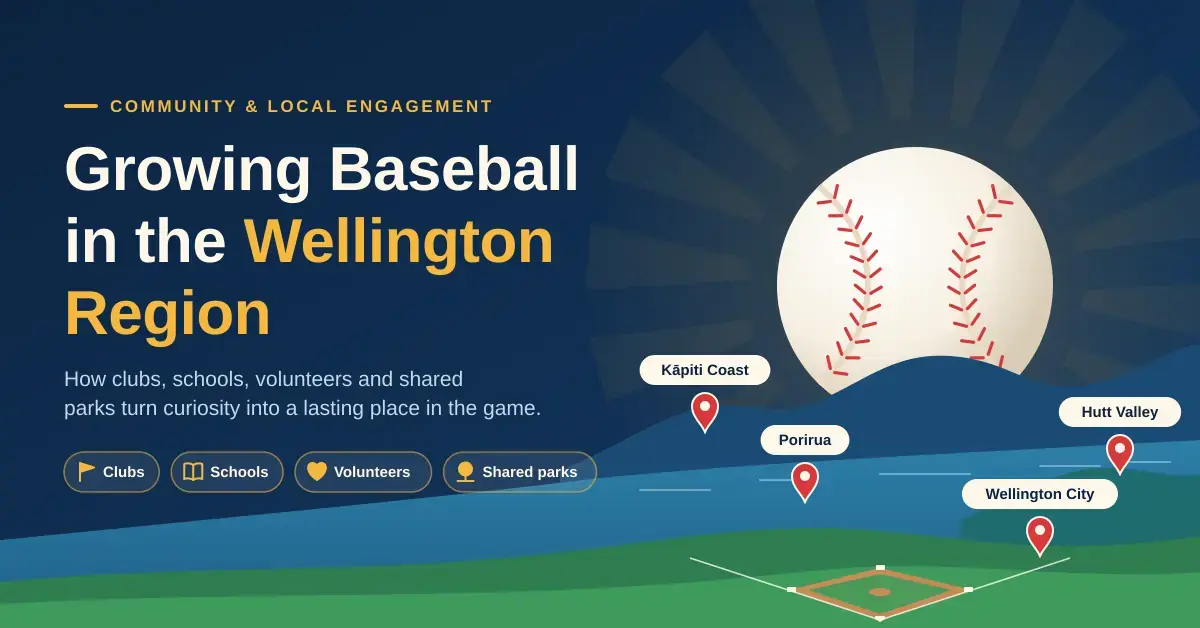
Baseball in the Wellington region grows one relationship at a time. Behind almost every new player there is a club volunteer, a school teacher who ran a taster session, a welcoming Sunday league or a council that agreed to share a park. This guide looks at how community and local engagement actually works across Wellington City, the Hutt Valley, Porirua and the Kāpiti Coast — the clubs, schools, volunteers, facilities and events that turn casual curiosity into a lasting place in the game.
Key Points
- Local hubs: Baseball in the region is organised through community clubs in Wellington City, the Hutt Valley, Porirua and the Kāpiti Coast.
- School pathways: T-Ball and the WBSC’s Baseball5 format introduce the sport to children with minimal equipment.
- Volunteer-led: Umpires, scorers, coaches and committee members keep club baseball running.
- Shared facilities: Clubs work with local councils to use multi-use parks alongside other sports.
- Open to everyone: Social grades and “Have a Go” days give beginners and adults an easy way in.
What community engagement means for Wellington baseball
Baseball is a minority sport in New Zealand, so its growth depends far more on grassroots connection than on national television coverage. The sport is governed by Baseball New Zealand, founded in 1989 and affiliated with the World Baseball Softball Confederation (WBSC); the men’s national team is known as the Diamondblacks. At the regional level, the Wellington Baseball Association coordinates clubs and competitions. “Community engagement” simply describes the ongoing work of keeping the sport anchored in the wider local community — recruiting players, supporting volunteers and making it easy for families to take part. If you are new to the scene, our overview of youth and community baseball in Wellington is a useful starting point.
Regional club hubs across the capital
Engagement in Wellington works best through local club hubs, which reduce travel and give families a nearby point of contact. The Wellington City Pirates play their home baseball at Ian Galloway Park, the Hutt Valley Hornets field grades from U12 through to Open, the Central Sports Club runs baseball and softball at Plimmerton Domain in Porirua, and the Kāpiti Coast Softball & Baseball Club has served its community since 1976. Many senior teams meet each Sunday in the Wellington Travel League, a regional competition with games played from the Wairarapa to Levin and from the Hutt Valley to Porirua. You can read more about the teams and competitions in Wellington baseball to see where each grade fits.
Club Hubs
| Region | Local club | Community focus |
|---|---|---|
| Wellington City | Wellington City Pirates (Ian Galloway Park) | Junior development through to senior travel-league teams |
| Hutt Valley | Hutt Valley Hornets | Family-friendly grades from U12 to Open, with Sunday competition |
| Porirua | Central Sports Club (Plimmerton Domain) | Baseball and softball for juniors and adults |
| Kāpiti Coast | Kāpiti Coast Softball & Baseball Club | Long-running community club, playing since 1976 |
How local clubs welcome newcomers
A club that feels approachable will always recruit more effectively than one that feels closed. The practical basics matter most:
- Clear, up-to-date club pages so families can find training times and contact people.
- Shared gear for beginners, so a first-timer usually needs only a glove to start.
- Post-game social time, such as a barbecue, that helps new families feel included.
- Friendly, well-marked grounds that make the sport visible to passers-by.
School and youth pathways
Schools are the most reliable long-term source of new players. The simplest entry points are T-Ball for younger children and Baseball5, a fast, low-cost format promoted internationally by the WBSC and used in New Zealand schools and clubs. Both remove the intimidation of a full game and focus on the core skills of throwing, catching, hitting and running. When a child’s first experience is positive, the move into a junior club team becomes natural — our guide to getting your child into baseball walks parents through that step, and there is a dedicated overview of Little League baseball in Wellington.
Baseball5 and the school-to-club pipeline
Baseball5 is a five-a-side, five-inning game played with nothing more than a small rubber ball on a compact square field, with bases roughly 13 metres apart. Because it needs no bats, gloves or protective gear, it can be run in a hall, a playground or a corner of a park, which makes it ideal for physical-education classes and taster days. Typical school-outreach activities include:
- Short in-school sessions led by club volunteers or coaches.
- Loan equipment so teachers can keep the activity going afterwards.
- Inter-school fun days that give children a first taste of friendly competition.
- A clear invitation to a nearby club for children who want to keep playing.
Volunteers: the engine of local baseball
Community baseball runs almost entirely on volunteers. Umpires, official scorers, team managers, coaches and the people who prepare the diamond before play all keep game day working. Sustaining that workforce means recognising people’s time and giving them a clear path to develop, including coaching and officiating training offered through the clubs and Baseball New Zealand.
Building a sustainable volunteer base
The easiest way to grow the volunteer pool is to make the step from spectator to helper feel small and well supported:
- Beginner-friendly clinics for new umpires and scorers.
- Mentoring that pairs newcomers with experienced committee members.
- Shared, rostered tasks so no single family carries the whole load.
- Simple recognition, from club kit to inclusion in end-of-season awards.
Facilities and working with local councils
Access to suitable grounds is the main limit on baseball’s growth in Wellington. Most diamonds sit on multi-use parks that are also used by winter codes such as rugby and football, and often shared with softball, so clubs work with the Wellington City, Hutt City, Porirua City and Kāpiti Coast District councils to secure space and improve facilities. Being a good neighbour to other sports — using removable or shared infrastructure and demonstrating steady participation — is central to winning support for upgrades such as backstops, cages and lighting.
Adult social baseball and inclusive grades
Community engagement is not only about children. Social and reserve grades give former players, complete beginners and residents from baseball-playing countries a relaxed way into the sport, often centred on the social side of a Sunday game. Lower-pressure grades broaden a club’s membership and help retain adults who might otherwise drift away. If you are thinking of trying it, our guide to what to expect at your first baseball practice takes the mystery out of turning up for the first time.
Community events and “Have a Go” days
Low-friction events are the single most effective recruitment tool. Open “Have a Go” days and club taster sessions let people pick up a bat within minutes, usually with loan gear, simple skill stations and a friendly barbecue. Registration is generally handled online through the Sporty platform that most New Zealand clubs use, so interested families can sign up on the spot or later at home. Keeping an eye on the local Wellington baseball schedules and fixtures is a good way to find these events and the start of each season.
A diverse, connected baseball community
Because baseball is played widely across the Americas and much of East Asia, Wellington’s leagues attract residents from many baseball-playing nations, who frequently help coach and mentor local players. That mix is a genuine strength of the capital’s baseball scene. Clubs stay connected between games through their Sporty pages and social media, which are used for fixtures, rain-out notices and celebrating results — practical tools that keep members engaged through the off-season as well as during play.
How to get involved
Getting started is straightforward: find your nearest club through Baseball New Zealand’s club finder or the Wellington Baseball Association, contact the club to ask about grades and training, and come along to a taster session or the start of a season. Most clubs will lend gear to beginners, so the main thing to bring is a willingness to give it a go — whether you want to play, coach, score or simply help out.
Sources
- Baseball New Zealand — Find a Club
- Baseball New Zealand — Diamondblacks national team
- World Baseball Softball Confederation — Baseball5
- Wellington City Pirates Baseball — Travel League information
- Hutt Valley Hornets Baseball Club — Sunday league
- Central Sports Club (Porirua)
- Te Ara — The Encyclopedia of New Zealand: Softball and baseball
Frequently Asked Questions (FAQ)
How do I find a baseball club near me in the Wellington region?
Use Baseball New Zealand’s online club finder or contact the Wellington Baseball Association. Clubs are spread across Wellington City, the Hutt Valley, Porirua and the Kāpiti Coast, so there is usually one within a reasonable distance.
Do I need experience to volunteer with a local club?
No. Clubs welcome help with scoring, team management, ground preparation and umpiring, and provide training for roles that need it, so you can start with little or no background in the sport.
Can adults and beginners start playing baseball in Wellington?
Yes. Social and reserve grades are designed for beginners, returning players and adults who want a relaxed introduction, and most clubs lend gear so newcomers usually only need to bring themselves.
What is Baseball5 and how does it help newcomers?
Baseball5 is a five-a-side, five-inning game played with just a rubber ball on a small square field. Because it needs no bats, gloves or protective gear, it is an easy, low-cost way for schools and clubs to introduce the sport.
How do clubs communicate game-day and weather updates?
Most Wellington clubs share fixtures, results and any weather-related cancellations through their Sporty pages and social media channels, which are the best places to check before heading to the diamond.