Baseball has a vocabulary all of its own, used both on the field and in the stands. For newcomers in New Zealand, that language can be the biggest barrier to enjoying a game – commentators rattle off words like “balk,” “slugging” and “can of corn” as if everyone already knows them. This glossary breaks the key terms into clear groups – the field, the equipment, pitching, defence, batting and the main statistics – so you can follow the action, read a box score and understand what coaches and broadcasters are talking about.
Key Terms at a Glance
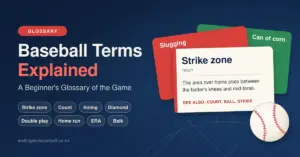
- Strike zone – the area over home plate between the batter’s knees and mid-torso.
- Count – the tally of balls and strikes, given balls first (e.g. 2-1).
- Inning – one turn at bat for each team; a standard game has nine.
- Diamond – the infield square formed by the four bases, 90 feet apart in adult play.
- Double play – two outs recorded in one continuous fielding sequence.
- Home run – a hit that clears the fence in fair territory and scores the batter.
- ERA / AVG – headline stats for pitchers (runs allowed per nine innings) and batters (hits per at-bat).
Basic Game Terms Every Fan Should Know
A handful of words describe the basic flow of every game. A pitch is a single throw from the pitcher to the batter. A strike is counted when the batter swings and misses, hits the ball foul (in most situations), or lets a pitch pass through the strike zone – the area over home plate between the batter’s knees and the midpoint of their torso. A ball is a pitch outside that zone that the batter does not swing at.
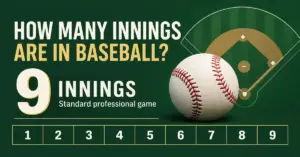
The running tally of these is called the count, always given as balls first, then strikes (for example, “2 and 1”). Three strikes make an out, and four balls earn the batter a free trip to first base, known as a walk. Each team bats until it records three outs, which completes a half-inning; a full inning is one turn at bat for each side. A standard professional game lasts nine innings. A run is scored when a player touches first, second and third base and returns to home plate.
Other common terms describe game situations. The on-deck circle is where the next batter warms up. A designated hitter (DH) is a player who bats in place of the pitcher without taking the field. A walk-off is any play that ends the game instantly with the home team taking the lead in its final at-bat.
The Baseball Field
The playing area is often called the diamond because of the square formed by the four bases. First, second and third base sit at the corners, with home plate completing the shape. In professional and most adult baseball the bases are 90 feet (about 27.4 metres) apart, measured between the back points of the bases; youth fields use shorter distances.
The infield is the dirt-and-grass square bounded by the bases, containing the pitcher’s mound – a raised circle from which the pitcher throws. Beyond it lies the outfield, the large grassed area split into left field, center field and right field, ending at the outfield fence.
Several other locations have their own names. The foul lines run from home plate through first and third base to the fence; anything inside them is fair, anything outside is foul territory. The dugout is the bench area where players wait, the bullpen is where relief pitchers warm up, and the warning track is the strip of dirt in front of the fence that tells outfielders the wall is near. Baseball fielding spots are also numbered 1 to 9, a shorthand used in scorekeeping.
Baseball Equipment Terms
Gear has its own vocabulary too. The bat may be wood or metal; solid wood bats are standard in professional leagues, while aluminium and composite bats are common in youth and amateur play. An official baseball is a cork-and-rubber core wound with yarn, covered in leather and stitched with 108 red double stitches. Under MLB Rule 3.01 it must weigh between 5 and 5.25 ounces (about 142-149 grams) and measure 9 to 9.25 inches (around 23 cm) in circumference.
Fielders wear a glove, and the design changes by position: a first baseman’s mitt and a catcher‘s mitt are heavily padded and have no individual fingers, while infielders use smaller, shallower gloves for quick transfers and outfielders use larger, deeper ones to track fly balls. A new glove usually needs to be worked in before it plays well – our guide on how to break in a baseball glove covers the safe methods.
Protective equipment is built into the rules. A batting helmet is compulsory for anyone hitting or running the bases. The catcher wears the most gear of all – a mask, chest protector and shin guards – because they crouch directly behind the plate. Most players also wear cleats, shoes with studded soles for grip on dirt and grass.
Pitching Terms
Pitching is where much of baseball’s strategy lives, and each pitch is named for how it moves. A fastball is thrown for pure speed with little movement. A sinker (or two-seam fastball) runs toward the pitcher’s throwing-arm side and drops. A cutter breaks slightly the other way at the last moment. Breaking balls move more sharply: a curveball drops from top to bottom, while a slider breaks sideways and down. A changeup is thrown with a fastball’s arm action but much slower, to upset the batter’s timing.
Pitch Types Compared
| Pitch | How it moves | Typical MLB speed |
|---|---|---|
| Four-seam fastball | Straight, little movement, appears to stay up | 150-160 km/h (93-99 mph) |
| Sinker / two-seam | Runs to the arm side and drops | 145-155 km/h (90-96 mph) |
| Cutter | Small, late break away from the arm side | 140-150 km/h (88-93 mph) |
| Slider | Sharp sideways-and-down break | 135-145 km/h (84-90 mph) |
| Changeup | Fastball arm action but slower, fades low | 130-140 km/h (81-87 mph) |
| Curveball | Large top-to-bottom break | 120-135 km/h (75-84 mph) |
Related terms describe how a pitch is delivered and judged. The windup and the set (or stretch) are the two legal stances a pitcher uses. A strikeout is an out recorded with three strikes. A balk is an illegal, deceptive motion by the pitcher with runners on base; when it is called, each runner advances one base. If you want the full rule, see our explainer on what a balk is and why it is penalised.
Defensive Terms
Fielders work together using a set of recognised plays. A double play records two outs in one continuous sequence, most often a ground ball turned from shortstop to second base to first. A force out happens when a runner must advance and a fielder reaches the base with the ball first; a tag out is when a fielder touches a runner who is off a base with the ball or glove holding it. An error is a misplay by a fielder that lets a batter or runner advance when an out should have been made.
Longer throws use a cut-off and a relay: an infielder positions themselves between the outfielder and the target base to shorten and redirect the throw. Teams also adjust where fielders stand. The defensive shift moves fielders toward the part of the field a batter tends to hit. Since 2023, MLB has limited the shift: four infielders must be on the infield dirt with two on each side of second base when the pitch is thrown, so the most extreme shifts are no longer allowed.
Batting Terms and Techniques
At the plate, a batter’s job is to reach base or drive in runs. Batted balls are described by how they travel: a line drive is hit hard and fairly flat, a grounder rolls or bounces along the infield, and a fly ball is hit high into the air. A pop-up is a short, very high fly, usually easy to catch.
Hits are classified by how many bases the batter reaches safely: a single (first base), a double (second), a triple (third) and a home run, which clears the fence in fair territory and scores the batter plus any runners on base. An infield hit is a single where the batter beats the throw on a ground ball that never leaves the infield.
Several techniques have their own names. Bunting is lightly tapping the ball into play, often to advance a runner. A sacrifice fly is a fly ball caught for an out that still allows a runner to score. Switch-hitting means a player can bat from either side of the plate, and a pinch hitter is a substitute batter sent in for a single at-bat. If you are learning to swing, our guide to hitting tips builds on these basics.
Common Baseball Statistics
Baseball is a game of numbers, and a few core statistics turn up constantly in commentary, player profiles and even baseball odds. Understanding them makes a box score far easier to read.
- Batting average (AVG) – hits divided by official at-bats; the simplest measure of how often a batter gets a hit.
- On-base percentage (OBP) – how often a batter reaches base via a hit, walk or hit-by-pitch.
- Slugging percentage (SLG) – total bases per at-bat, rewarding extra-base hits.
- On-base plus slugging (OPS) – OBP and SLG added together, a quick all-round measure of a hitter.
- Runs batted in (RBI) – runs a batter drives home with a hit or productive out.
- Earned run average (ERA) – the earned runs a pitcher allows per nine innings.
For pitchers, WHIP (walks and hits per inning pitched) is another standard gauge of control and run prevention. Lower is better for ERA and WHIP; higher is better for AVG, OBP, SLG and OPS.
Baseball Slang You’ll Hear
Beyond the official terms, fans and players use plenty of informal slang. Knowing a few makes commentary far more fun to follow:
- Dinger – a home run.
- Heater or gas – a fast fastball.
- Can of corn – an easy, routine fly-ball catch.
- Wheelhouse – the part of the strike zone a batter hits best.
- Frozen rope – a hard, flat line drive.
- Dish – home plate.
Who This Glossary Is For
You do not need to memorise every term at once. New fans can start with the basic game terms and the field, newcomers watching MLB will pick up the pitching and statistics sections, and parents of junior players in Wellington will find the equipment and batting terms most useful on the sideline. Keep this page handy and the words will stick naturally the more baseball you watch and play.
Responsible Gambling
This article is an educational glossary, not betting advice. Some baseball terms appear in sports-betting contexts, but understanding terminology does not improve anyone’s chances of winning a wager, and betting outcomes are always uncertain. Sports betting in New Zealand is restricted to adults aged 18 and over, and the only locally licensed operator is the TAB; offshore betting sites are not regulated under New Zealand law. If gambling is causing harm for you or someone you know, free, confidential help is available from the Gambling Helpline on 0800 654 655.
Sources
Frequently Asked Questions
What are the most important baseball terms for beginners?
Start with the words that describe the flow of play: strike, ball, the count, out, inning, run, walk and home run. Once those make sense, add the main field terms (infield, outfield, mound, bases) and a couple of statistics such as batting average and ERA. These cover most of what a commentator will say in a typical game.
What is baseball slang?
Baseball slang is the informal language fans and players use alongside the official terms. A “dinger” is a home run, a “heater” is a hard fastball, a “can of corn” is an easy fly-ball catch, and a batter’s “wheelhouse” is the zone they hit best. These expressions are widely understood among baseball followers but rarely appear in the rulebook.
What are the different types of hits in baseball?
Hits are named for how many bases the batter reaches safely. A single reaches first base, a double reaches second, a triple reaches third, and a home run clears the fence and scores the batter along with any runners on base. An infield hit is a single on a ground ball where the batter beats the throw to first.
What do the batting stats AVG, OBP and SLG mean?
Batting average (AVG) is hits divided by at-bats, so it measures how often a batter gets a hit. On-base percentage (OBP) adds walks and hit-by-pitches to show how often a batter reaches base at all. Slugging percentage (SLG) counts total bases per at-bat, giving more weight to doubles, triples and home runs. Combined, OBP and SLG form OPS.
What is the difference between the infield and the outfield?
The infield is the square of dirt and grass bounded by the four bases, where the pitcher’s mound sits and most ground balls and quick plays happen. The outfield is the larger grassed area beyond it, divided into left, center and right field, where fly balls are usually caught. Infielders field close to the bases; outfielders cover the deep areas near the fence.