
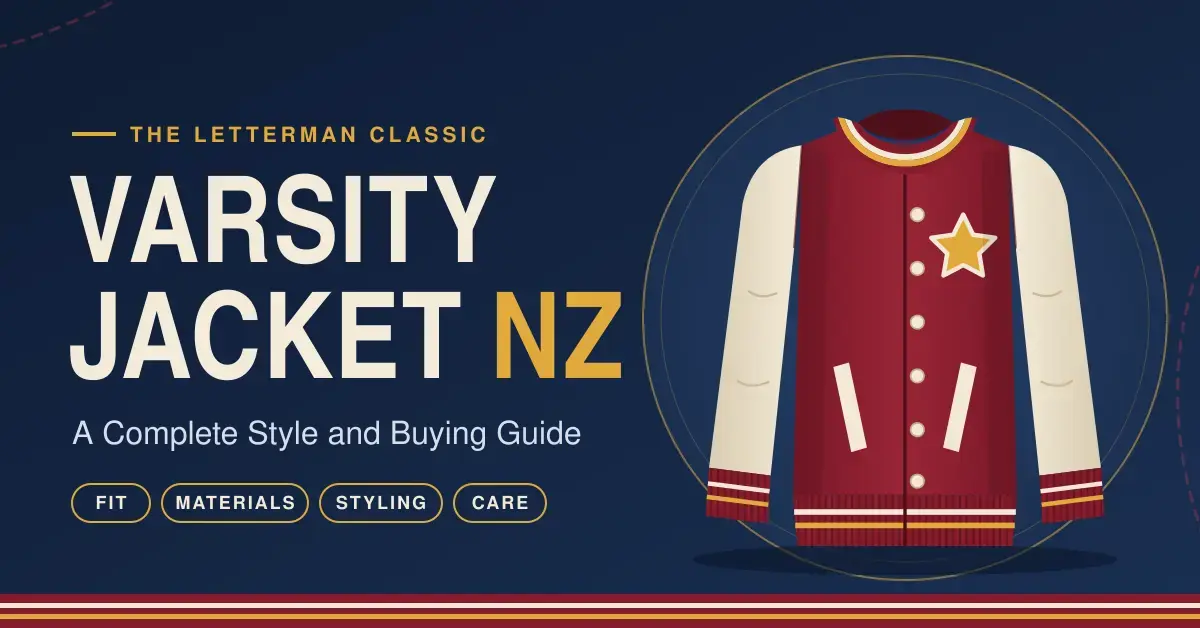
The varsity jacket, often called the letterman jacket, has long stood for athletic achievement and school pride. It began on American university sports fields in the 19th century and has since grown into a global wardrobe staple. Its recognisable mix of a wool body, contrasting leather sleeves, a button or snap front and ribbed knit trims makes it instantly familiar — and surprisingly versatile for the New Zealand climate.
Whether you want a traditional wool-and-leather jacket for winter or a lighter, baseball-inspired layer for the shoulder seasons, choosing the right varsity jacket comes down to fit, materials and how you plan to wear it. This guide explains where the style came from, how a good one is built, and how to select, style and care for yours so it lasts for years.
Key Points
- What it is: A wool-body jacket with leather sleeves and ribbed knit trims, born from 1865 Harvard baseball sweaters.
- Core materials: Melton wool body, full-grain or vegan leather sleeves, high-tension ribbing.
- Fit tip: The sleeve seam should sit at the edge of your shoulder; cuffs at the wrist bone.
- NZ seasons: Wool for winter, cotton or nylon for spring and autumn, vests for summer.
- Care: No machine washing — brush the wool, condition the leather, dry-clean when needed.
The origins and evolution of the varsity jacket
The story starts in 1865 at Harvard University, where members of the baseball team wore heavy grey flannel sweaters with a large Old English “H” stitched to the chest. The letter marked membership of the team, and it carried real status: only players who featured in important games were allowed to keep their sweater, while reserves handed theirs back at the end of the season.
Over the following decades the design toughened up for cold-weather sport. By the 1930s the knitted sweater had given way to the silhouette we recognise today — a warm wool body paired with hard-wearing leather sleeves, finished with a ribbed collar, cuffs and hem. Large chenille letters (a fuzzy, looped-yarn patch) displayed the school’s initial, and additional patches recorded team or personal achievements.
Although the jacket is rooted in American collegiate life, it travelled well. In New Zealand it has been adopted through a shared love of American sport and streetwear, sitting comfortably between nostalgic sports memorabilia and everyday urban fashion. You can trace more of that sporting lineage in our look at who invented baseball.
Anatomy of a varsity jacket: materials and construction
A well-made varsity jacket should feel substantial without being stiff. Knowing what goes into one helps you judge quality before you buy.
- The body: High-grade melton wool is the traditional choice. Melton is a dense, tightly woven wool that resists wind and pilling and holds its shape, which is why it has been the standard for well over a century.
- The sleeves: Full-grain leather is the classic option; it is durable and develops an attractive patina over time. Good synthetic (vegan) leather is a lighter, lower-maintenance and animal-free alternative.
- The ribbed trims: The collar, cuffs and hem use elasticated ribbing. Look for thick, high-tension knit that springs back into shape rather than stretching out and going baggy.
- The construction: Check the seams, especially where the sleeves meet the shoulders. Reinforced, even stitching is a reliable sign of a jacket that will survive regular wear.
- The closures and lining: Snap buttons give the vintage look; hidden zips or heavy press-studs block wind better. Linings range from lightweight satin for milder days to quilted insulation for genuine warmth.
Men’s varsity jackets and modern fits
The varsity jacket strikes a balance between sporty and smart-casual. Traditional cuts were deliberately boxy and roomy to fit over sports gear and layers. Modern versions sold in New Zealand tend to be more tailored, with tapered sleeves and a closer line through the torso that works over a slim shirt or a fine knit.
The signature striped ribbing at the collar and cuffs stays put in almost every version, giving that snug seal against the cold. Whether you choose a bold colour-blocked design or a quieter monochrome one, a considered fit keeps the look sharp without losing the comfort that made the original popular. For matching your headwear, our guide to baseball caps in NZ pairs well with a casual varsity outfit.
Varsity jacket vs baseball jacket vs bomber
These names are often used loosely, so it helps to see how the classic styles differ. A “varsity jacket” strictly means the collegiate version with team letters; a “baseball jacket” is the broader button-up style worn by ball players; and a bomber is a separate, single-material design borrowed from flight jackets.
Comparison
| Style | Typical body | Sleeves | Defining feature | Best for |
|---|---|---|---|---|
| Varsity (letterman) | Melton wool | Leather or vegan leather | Chenille team letters and patches | Classic collegiate look, cooler weather |
| Baseball jacket | Wool, cotton or nylon | Matching or contrasting | Button-up, collared, sporty cut | Everyday sporty layering |
| Bomber | Nylon or leather (single material) | Same as body | Zip front, no lettering | Minimal, streetwear styling |
| Harrington | Cotton or poly-cotton | Same as body | Lightweight, tartan lining | Mild, dry days |
If a lighter shell is what you’re really after, compare notes with our guides to the windbreaker jacket and to heavier professional coats before deciding.
How to choose the right varsity jacket in NZ
Start with a fit that suits your lifestyle. Traditional cuts are relaxed and leave room for layers; contemporary versions cater to slim, straight or cropped shapes. Whichever you prefer, check these points:
- Shoulder fit: The sleeve seam should sit right at the edge of your shoulder. Too low looks sloppy; too high restricts movement.
- Sleeve length: Cuffs should reach the base of your wrist. If you layer heavily, leave a little extra room underneath.
- Colour versatility: For a first jacket, a neutral palette such as black-on-black or navy-and-grey pairs with almost anything you already own.
- Budget: Genuine wool and leather usually cost a bit more, but they last. Cheaper synthetic blends can be fine for a single season yet rarely wear as well as natural fibres over time.
Styling and the best occasions to wear one
You don’t need to be an athlete to wear a varsity jacket. It adapts to a range of settings:
- Casual weekends: Over a plain t-shirt with dark denim and trainers for the market or a walk along the Wellington waterfront.
- Smart-casual evenings: Swap the trainers for leather Chelsea boots and wear the jacket over a crisp shirt or a fine merino knit for dinner.
- Academic and reunion events: A subtle nod to school or club history that still keeps you warm at outdoor gatherings.
Personalising your varsity jacket
A big part of the jacket’s appeal is how easily it can be personalised to represent a team, club or your own taste. When customising, think about:
- Materials: Beyond wool and leather, consider vegan leather sleeves, cotton twill or performance nylon for a lighter, more weather-resistant feel.
- Colour blocking: Contrasting piping and matched cuffs and collars for a classic look, or a single tone for something minimal.
- Embellishment: Chenille patches, embroidery or tackle-twill lettering on the chest, back or sleeves for names, numbers or logos.
- Adding patches later: A plain jacket can be taken to a tailor or embroidery shop afterwards. Ask them to use an industrial needle and thread so patches don’t tear the wool or leather.
Caring for wool and leather
Because a varsity jacket mixes materials, it needs a little more thought than a single-fabric coat:
- Keep it out of the washing machine. Use a lint roller or a soft brush to lift dust and hair from the wool body.
- Wipe leather sleeves with a slightly damp cloth, then apply a leather conditioner now and then to keep them supple and prevent cracking.
- For a deep clean, use a professional dry cleaner experienced with mixed-material garments rather than risking it at home.
- Store it on a broad hanger away from direct heat so the wool keeps its shape and the leather doesn’t dry out.
Varsity jackets across New Zealand seasons
New Zealand weather is famously changeable, and the varsity jacket adapts across the year:
- Summer: Sleeveless varsity vests keep the sporty look while letting air move on cooler evenings.
- Autumn and spring: Lighter cotton or nylon versions keep the breeze off without overheating when the sun appears.
- Winter: Layer a wool-body jacket over a cable-knit jersey or hoodie, and add a scarf for extra wind protection.
Rounding out a sports-inspired wardrobe, our baseball jersey guide covers another classic layer that sits naturally alongside a varsity jacket.
Sources
Frequently asked questions
What defines a classic varsity jacket?
A classic varsity jacket has a wool body, contrasting leather sleeves and ribbed knit collar, cuffs and hem, usually with snap-button closures. The mix of materials and the collegiate lettering set it apart from a single-fabric bomber.
Is there a difference between a baseball jacket and a varsity jacket?
In everyday use the terms overlap. Strictly, a varsity jacket is the collegiate style with team letters, while a baseball jacket is the broader button-up, collared design worn by ball players. Both share the ribbed knit cuffs and hem.
Are varsity jackets suitable for New Zealand weather?
Yes. The traditional wool-and-leather build gives good insulation for winter, while lighter cotton or nylon versions suit the milder, unpredictable transitional seasons.
How do I maintain the wool and leather?
Keep it out of the washing machine. Brush or lint-roll the wool, wipe leather with a damp cloth and condition it occasionally, and use a specialist dry cleaner for deep cleaning.
Can I add my own patches to a store-bought jacket?
Yes. A tailor or embroidery shop can add patches, logos or initials to a plain jacket. Ask them to use an industrial needle and thread so the wool or leather isn’t damaged.