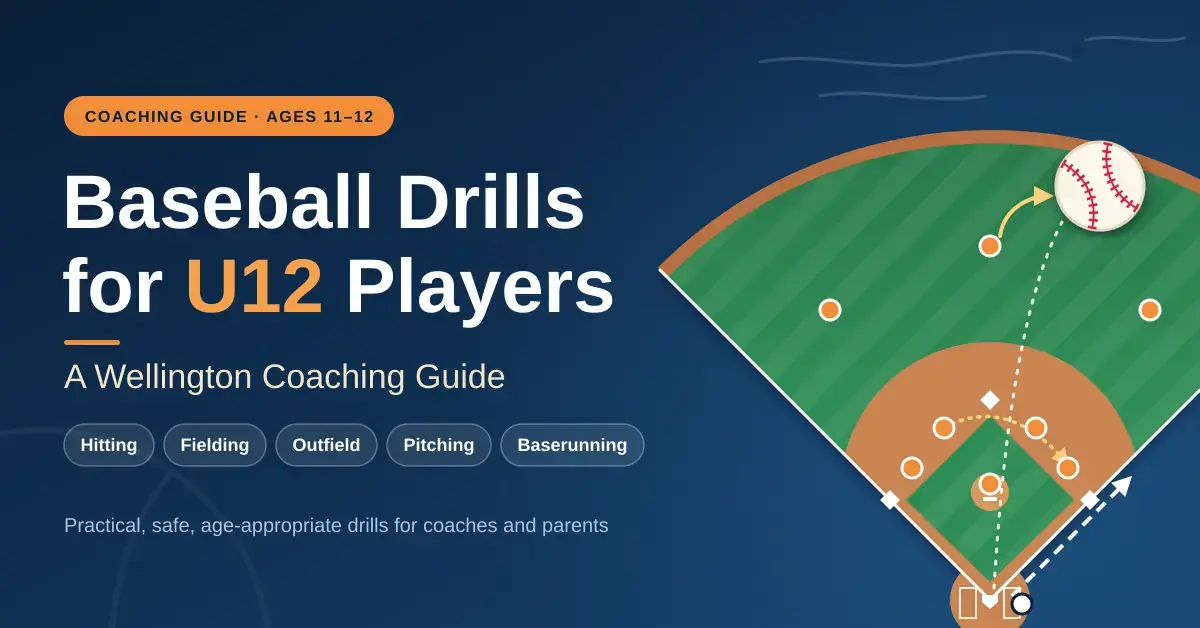
Coaching 11 and 12-year-old baseball players means bridging the gap between a first taste of the sport and genuinely competitive play. At this stage — known in New Zealand as the Major League (12U) grade — young athletes are ready to move on from simple throw-and-catch routines and start refining the mechanics behind hitting, fielding, pitching and baserunning. This guide sets out practical, safe and age-appropriate drills that Wellington coaches and parents can use to build well-rounded players, along with the field dimensions, pitch-count limits and practice structure that matter most for this age group.
Key Points
- Hitting: use tee work to fix swing path and soft/front toss to build timing.
- Fielding: develop soft hands with short hops and the ready-position funnel technique.
- Outfield: teach the drop step and clear calls instead of backpedalling.
- Pitching: prioritise control from 46 feet and follow Pitch Smart limits; avoid curveballs at this age.
- Baserunning: run through first, round bases efficiently and slide feet-first with hands up.
- Team IQ: use situational drills so players learn where to throw the ball.
Understanding the U12 stage in New Zealand baseball
Most Kiwi children first meet the game through KiwiBall, Baseball New Zealand’s entry-level programme built around six levels that match the six years of primary school. Its aim is simple: make a player’s first experience fun so they stay in the sport. From there players progress through Cub Ball and T-Ball into the Minor League (10U) grade, and then into the Major League (12U) grade, where games become more structured and results start to count.
The 12U diamond keeps the bases about 60 feet (roughly 18.3 metres) apart, with pitchers throwing from 46 feet (about 14 metres) — not the longer 50-foot distance used by the older Intermediate (13U) division. Those numbers matter for training, because drills should be run at game-realistic distances so that timing and arm strength carry over to match day. For a wider look at how players move up the grades, see our overview of the baseball skills development pathway.
The fundamentals below are the same ones professional players drilled as children. Highly rated prospects such as Max Clark spent years on repetitive youth practice long before reaching the top of the game — a reminder that consistency, not shortcuts, is what develops young talent.
Quick Facts
| NZ grade | Major League (12U) |
| Ages | 11–12 years |
| Base distance | About 60 feet (18.3 m) |
| Pitching distance | 46 feet (about 14 m) |
| Daily pitch limit (11–12) | 85 pitches, with rest days by count (Pitch Smart) |
| Recommended pitches | Fastball and change-up; no curveballs |
| Typical practice length | 1–2 hours |
Hitting drills: tee work, soft toss and front toss
The batting tee remains the single most useful hitting tool at this age because it gives instant feedback. If a player keeps clipping the back of the tee, they are usually dropping their hands and swinging under the ball. Moving the tee around the strike zone teaches a young hitter to cover inside, outside, high and low pitches while keeping a level swing. For more on stance and swing, our baseball hitting tips pair well with the drills here.
Getting the most from the batting tee
- Inside and outside placement: teaches hitters to pull inside pitches and drive outside pitches to the opposite field.
- High and low drills: changing tee height forces a consistent swing plane instead of chopping down or uppercutting.
- Double-tee drill: two tees set in a line stop a looping, "casting" swing by making the batter stay direct to the ball.
- One-handed drills: using only the top or bottom hand builds the specific strength and control each hand contributes.
Soft toss versus front toss
Moving from a still ball to a moving one is a big step. In soft toss, a partner gently tosses balls underhand from the side so the hitter focuses on clean contact and driving the ball into a net. Front toss is the next stage up: a coach throws underhand from behind a screen in front of the batter, creating a more realistic ball path that starts to build pitch recognition and timing.
| Feature | Soft toss | Front toss |
|---|---|---|
| Angle of feed | 45–90 degrees from the side | Directly in front, behind a screen |
| Speed | Slow and controlled | Medium, realistic ball path |
| Main goal | Barrel control and swing mechanics | Timing and pitch recognition |
Fielding drills for infield and outfield
Defence at 12U rewards balance and repetition. The aim is to remove the fear of the ball and build reliable, repeatable footwork rather than flashy plays.
Building soft hands in the infield
"Soft hands" simply means catching the ball smoothly rather than stabbing at it. High-repetition drills with tennis balls or soft training balls let players focus on technique without flinching.
- Ready position: knees bent and glove out front so the first step is quick.
- Short-hop drill: a partner throws firm hops from close range to practise glove-side and backhand picks.
- Kneeling catch: fielding on the knees removes footwork so players concentrate purely on glove work.
- Funnel and pivot: absorbing the ball toward the body, then turning the feet to the target for an accurate throw.
Tracking fly balls in the Wellington wind
Wellington’s breeze makes outfield play a real skill. The most important habit is the drop step: instead of backpedalling (which is slow and unsafe), the fielder takes a quick first step back at an angle, turns and runs while keeping the ball in sight. Clear calls such as "Mine!" prevent collisions between converging players. Regular fly-ball repetitions and simple relay-throw practice to a cut-off player round out outfield sessions.
Pitching drills and protecting young arms
At 12U the priority is control and safe mechanics, not raw speed. A repeatable release point is the fastest route to throwing more strikes. Target practice using cones or buckets in the strike zone, plus the classic towel drill (going through the full motion holding a towel to feel the arm path without the stress of a throw), both build consistency. For a deeper breakdown of the delivery, read our baseball pitching mechanics guide, and work alongside it on throwing accuracy.
Arm safety is non-negotiable. The MLB and USA Baseball Pitch Smart guidelines set a daily maximum of 85 pitches for ages 11–12, with graduated rest days — for example, 66 or more pitches requires four days’ rest before pitching again. Pitch Smart also advises that players aged 9–12 stick to fastballs and change-ups and avoid breaking pitches such as curveballs, which add strain to developing elbows. In short, teach location and a clean change-up rather than rushing into curveballs.
Baserunning drills
Good baserunning is about awareness as much as speed. Efficient technique can win bases without a single extra step of pace.
- Running through first: sprinting hard through the bag on ground balls, never slowing down early.
- Rounding the bases: taking a slight banana-shaped path to touch the inside corner of each base.
- Tagging up: practising when to advance from third on a caught fly ball.
- Safe sliding: a feet-first, hands-up slide into a soft surface to stay within the rules and avoid hand and wrist injuries.
Position-specific and team situational drills
By ages 11 and 12, players start to specialise, and small-group work lets coaches give focused feedback. Catchers build the strength and flexibility for a low, balanced squat and clean receiving in full gear; first basemen practise scooping off-target throws and stretching to the bag; and middle infielders (shortstop and second base) rehearse quick, safe double-play feeds.
Once individual skills are solid, situational drills tie them together. Setting up runners on base and calling out the number of outs forces the defence to decide where the ball should go. Common scenarios include turning a double play with a runner on first, making the play at home with the bases loaded, and using a cut-off player to hold a runner after an outfield hit. These reps build the "baseball IQ" that separates competitive teams from purely athletic ones.
Structuring practice and off-season training
A well-run U12 session usually lasts one to two hours: a dynamic warm-up, individual skill blocks, then team scenarios or a scrimmage. Keeping segments short and varied holds attention and packs in more quality repetitions. Sensible warm-ups and clear rules also reduce injuries — our notes on baseball safety for young players are worth reading before the season starts.
New Zealand’s winter is the ideal time to build a fundamental base indoors, when the summer competition is over. Batting cages, arm-care and long-toss programmes, and agility work in a confined space all keep skills sharp so players arrive fit and fundamentally sound for spring. Coaches wanting more year-round ideas can adapt our general youth baseball drills to suit the 12U group.
This article is general coaching information, not medical or professional advice. Follow Pitch Smart pitch-count and rest guidance, use qualified coaching, and seek medical advice for any pain or injury before a young player continues throwing.
Reference sources
Frequently asked questions
What is the pitching and base distance for U12 baseball in New Zealand?
Standard 12U (Major League grade) baseball uses bases about 60 feet apart with a pitching distance of 46 feet. The longer 50-foot pitching distance belongs to the older Intermediate (13U) 50/70 division, not to U12.
Should U12 pitchers throw curveballs?
Generally no. Pitch Smart recommends that players aged 9–12 throw only fastballs and change-ups and avoid breaking pitches like curveballs, which add strain to young elbows. At this age the goal is command and a reliable change-up, not new pitch types.
How many pitches can an 11 or 12-year-old throw in a day?
The Pitch Smart daily maximum for ages 11–12 is 85 pitches, followed by graduated rest days based on how many pitches were thrown. Higher counts require more days off before that player pitches again.
Why is tee work still useful for 12-year-olds?
The tee lets players groove good mechanics through repetition without the pressure of a moving ball, and it gives instant feedback on swing path. It complements, rather than replaces, soft toss and live hitting.
How long should a typical U12 practice last?
Around one to two hours works well: a warm-up, individual skill blocks, then team scenarios. Short, varied segments keep young players engaged and maximise quality repetitions.
What is KiwiBall?
KiwiBall is Baseball New Zealand’s entry-level programme, structured in six levels that align with the six years of primary school. It introduces the sport in a fun, low-pressure way before players move into graded, competitive baseball.