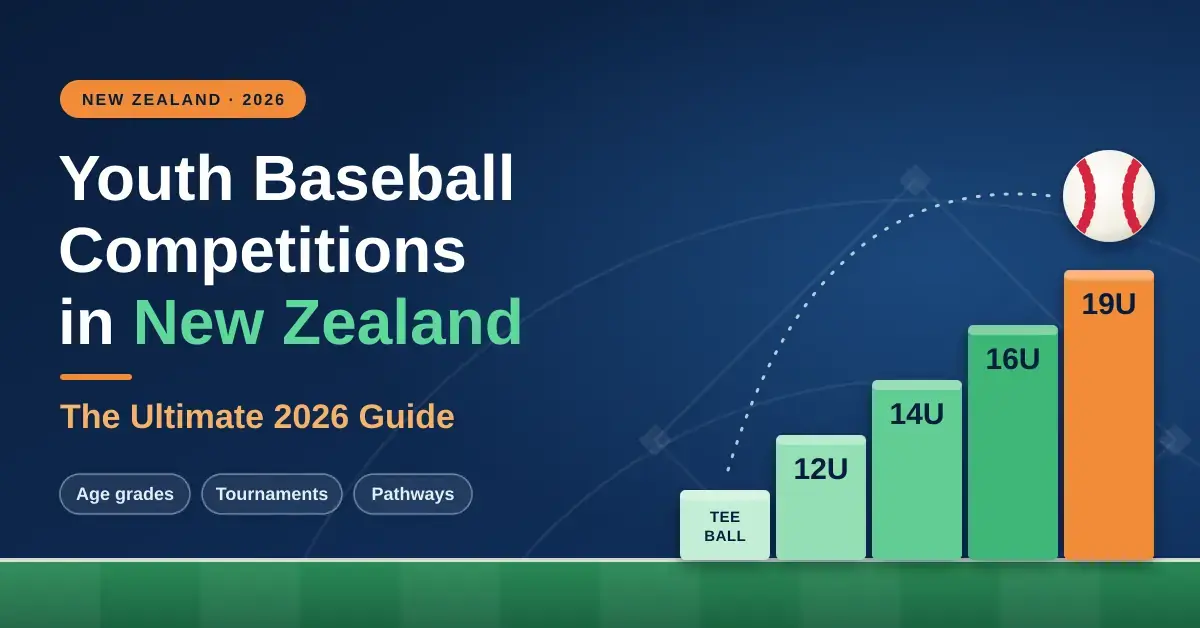
Youth baseball in New Zealand runs on a clear seasonal ladder, from first-swing Tee Ball through age-graded club leagues to national tournaments and a representative pathway that can end in the black jersey of the Diamondblacks. This guide maps the 2026 landscape for parents and players: how the age grades work, which competitions matter, what happens in the Wellington region, and how a young athlete progresses from a Sunday club game to national selection. It is written for newcomers, so each grade, diamond size and tournament is explained in plain terms.
Key Points
- Age grades: Tee Ball leads into 12U (Little League), 14U (Junior League), 16U (Senior League) and 19U (Big League).
- Diamond jump: players move from the 60/46-foot Little League field to the full 90-foot senior diamond at 14U.
- Wellington play: WBA clubs (Wellington City Pirates, Hutt Valley Hornets, Levin Hustle) compete in a regional Sunday travel league.
- National tournaments: the Mid-Summer Blast (Levin, drafted teams), the Little League All-Star Series and the Summer Showdown (Tauranga) headline the calendar.
- Pathway: development hubs and national squads lead to U-15/U-16 teams and, ultimately, the Diamondblacks.
How New Zealand’s youth age grades work
Competitive youth baseball in New Zealand is organised by age using an “under” system, closely aligned with Little League and Babe Ruth structures. The youngest players start with Tee Ball, where the ball is hit from a stationary tee to build coordination and confidence rather than to keep score. From there, players move into pitched-ball grades that grow in size and speed as they age.
The main youth divisions are 12U (Little League), 14U (Junior League) and 16U (Senior League), with 19U (Big League) acting as the bridge into adult Premier baseball. A key milestone is the jump from the smaller Little League diamond to the full-sized senior field, which happens at the 14U grade.
Diamond sizes by grade
A “diamond” is the baseball infield; its two key measurements are the distance between bases (the base paths) and the pitching distance from the mound to home plate. Youth grades use scaled dimensions so that skills develop safely before players face full-sized fields.
- Tee Ball (approx. 4–7): shortened base paths, no pitching — the focus is fun and fundamentals.
- 12U / Little League: 60-foot base paths with a 46-foot pitching distance.
- 14U / Junior League: steps up to the full-sized senior diamond — 90-foot base paths and a 60-foot 6-inch pitching distance.
- 16U / Senior League: played on the full adult diamond, a genuine high-performance grade.
- 19U / Big League: the final youth tier and a direct pathway into Premier senior competition.
| Division | Typical age | Base paths / mound | Emphasis |
|---|---|---|---|
| Tee Ball | 4 – 7 | Short / none | Fundamentals & fun |
| 12U (Little League) | 9 – 12 | 60ft / 46ft | Player-pitch skills |
| 14U (Junior League) | 13 – 14 | 90ft / 60ft 6in | Tactical development |
| 16U (Senior League) | 15 – 16 | 90ft / 60ft 6in | High performance |
| 19U (Big League) | 17 – 19 | 90ft / 60ft 6in | Bridge to senior play |
If you are still deciding where a child fits, our overview of Little League baseball in Wellington explains the entry grades in more detail, and the guide to Kiwi player skill progression shows how development builds from grade to grade.
Youth baseball in the Wellington region
In the lower North Island, the Wellington Baseball Association (WBA) is the governing body for local youth baseball, offering Tee Ball plus 12U Majors, 14U Juniors and 16U Seniors. Rather than each club running an isolated league, much of the region’s competitive youth play happens through the Wellington Travel League — a regional Sunday competition with games spread from the Wairarapa and Levin through to Hutt City and Porirua. Sunday scheduling lets players who also play traditional Saturday winter sports take part.
Active clubs include the Wellington City Pirates, based at Ian Galloway Park, and the Hutt Valley Hornets in the Hutt region, with the Levin Hustle providing a northern hub for travel-league fixtures. Clubs commonly run “have a go” style sessions in spring to welcome beginners before the summer season.
- Wellington City Pirates: centrally located club focused on junior and development grades.
- Hutt Valley Hornets: Hutt-based club fielding youth teams across the age grades.
- Levin Hustle: a growing club that regularly hosts multi-club travel-league games.
For fixtures and venues, see the 2026 Wellington schedules and fixtures, and for a roster of local sides across the grades, our list of Wellington baseball teams from Little League to senior grades. If your child is brand new to the sport, getting your child into baseball in NZ walks through the first steps.
The 2026 national youth tournament calendar
The national circuit is where the best youth talent meets, and several fixtures anchor the summer. The season builds toward late-summer and autumn championships run or sanctioned by Baseball New Zealand and its charter holders.
2026 National Youth Tournament Calendar
| Event | Window (2026) | Location | Grades / format |
|---|---|---|---|
| Mid-Summer Blast | Early January | Levin | 12U–16U, drafted teams (NZ Babe Ruth Nationals) |
| Little League All-Star Series | 6–8 February | Charter regions | Regional All-Star teams, international qualifier |
| Summer Showdown | 9–12 April | Tauranga | Top 14U and 16U club teams |
Two contrasting formats
Two flagship youth events show the range of NZ competition. The Mid-Summer Blast, held in early January in Levin, uses a drafted-team format: players register as individuals and are drafted into new teams rather than turning out for their home clubs. Around 150 athletes take part, 14U games are played under lights at the Levin Domain, and the event doubles as the New Zealand Babe Ruth National Championships. The draft is deliberate — it mixes players from rival regions to broaden their experience and connections.
The Summer Showdown, by contrast, is about club prestige. Scheduled for 9–12 April 2026 in Tauranga, it brings the country’s top 14U and 16U club teams together to contest a national title and traditionally closes the competitive summer. Between them sits the Little League All-Star Series (6–8 February 2026), where regional charter teams play off for the New Zealand Little League title and the associated international berth. A full regional view is available in our Wellington baseball tournament calendar.
The representative pathway to the Diamondblacks
For ambitious players, national tournaments are also talent-identification events. Baseball New Zealand runs a structured player pathway built around regional development hubs in Auckland and Wellington, so athletes can access quality coaching without constant travel. Standout players aged roughly 12–16 can be invited into a National Development Squad, which follows a multi-week off-season and pre-season training block and a development camp during the October school holidays.
From there the pathway leads to age-group national teams — including U-15 and U-16 sides — that contest events such as the WBSC Oceania U-15 qualifier, and ultimately to the U-18, U-23 and men’s Diamondblacks teams for international tours and qualifiers. Selection weighs athleticism and physical tools alongside game awareness, coachability and resilience under pressure.
What selectors look for
- Physical tools: speed, arm strength and athleticism that translate to a bigger diamond.
- Baseball IQ: reading situations, positioning and decision-making at game speed.
- Consistency and attitude: reliable performance across a tournament and the ability to handle setbacks.
Competitive standards: scoring and statistics
From 14U upward, grades are generally treated as competitive, meaning results, standings and individual statistics are recorded. Statistics such as batting average, ERA (earned run average — runs a pitcher allows per nine innings) and fielding percentage build a player’s record over a season and support regional and national selection.
Clubs typically use digital tools for this. Live scoring and team-management apps let coaches and families follow play-by-play, while national platforms hold official schedules, registrations and confirmed standings. A tidy statistical record also becomes useful for players later exploring United States college opportunities.
- Live scoring apps: real-time play-by-play and team management during games.
- Official league portals: the source of truth for draws, registrations and standings.
- Player records: a season of verified stats that follows a player up the grades.
Auckland: the country’s largest youth hub
While Wellington is a key centre, the Auckland Baseball Association (ABA) runs the country’s largest junior competition, spanning 12U through to older youth grades and played predominantly on Saturdays. Established clubs such as North Shore, Howick-Pakuranga and West City field strong youth programmes; North Shore, for example, plays its 14U Junior League games on Saturdays under Little League rules. Auckland sides are a common benchmark for Wellington teams when they meet at national tournaments, which is one reason travel and cross-regional play matter so much to youth development.
Safety and equipment for youth grades
Player welfare is central to competitive youth baseball. In competitive grades, male players are required to wear an athletic protector, and all batters and base runners must wear a helmet that covers both ears. Catchers use full protective gear including a throat guard, and bat rules vary by grade (for example USA Baseball, BBCOR or wood standards for different ages) to keep the game safe and fair.
- Batting helmets: mandatory for every batter and base runner.
- Catcher’s gear: mask with throat protection, chest protector and shin guards.
- Footwear: rubber or moulded cleats for youth grades rather than metal spikes.
- Personal kit: clubs usually share bats and helmets, but players are expected to bring their own glove.
For a plain-language checklist aimed at families, see our baseball safety tips for kids in Wellington.
Who youth competition suits
New Zealand’s youth baseball structure is broad enough to fit different goals. A child who simply wants a fun, social summer sport can thrive in Tee Ball or a local 12U team without any pressure to specialise. A committed teenager chasing high performance can use the 14U and 16U grades, national tournaments and the development squads as genuine stepping stones toward representative baseball. The common thread is the volunteers, coaches and families who keep clubs running — the real engine of the game in Aotearoa.
Reference sources
Frequently Asked Questions (FAQ)
When is the youth baseball season in New Zealand?
Youth baseball is a summer sport, with club leagues typically running from around October to April and the major national tournaments concentrated between January and April.
What age grades are available for youth players?
The main grades are 12U (Little League), 14U (Junior League), 16U (Senior League) and 19U (Big League), with Tee Ball as the entry point for the youngest players.
How do I find a youth baseball club in Wellington?
Clubs such as the Wellington City Pirates (Ian Galloway Park) and the Hutt Valley Hornets field youth teams, and the Wellington Baseball Association can point new families to the nearest option and the regional Sunday travel league.
Can beginners join competitive grades like 14U?
Yes. Clubs actively welcome newcomers and coach fundamentals first, so a player can learn the basics before stepping into competitive league play.
Are games played on Saturdays or Sundays?
It depends on the region. Auckland youth games are generally played on Saturdays, while Wellington’s regional travel-league fixtures are played on Sundays.
How does a young player reach the national team?
Strong performers can be selected into a National Development Squad through regional hubs and national tournaments, then progress to U-15 and U-16 sides and, ultimately, the U-18, U-23 and men’s Diamondblacks teams.