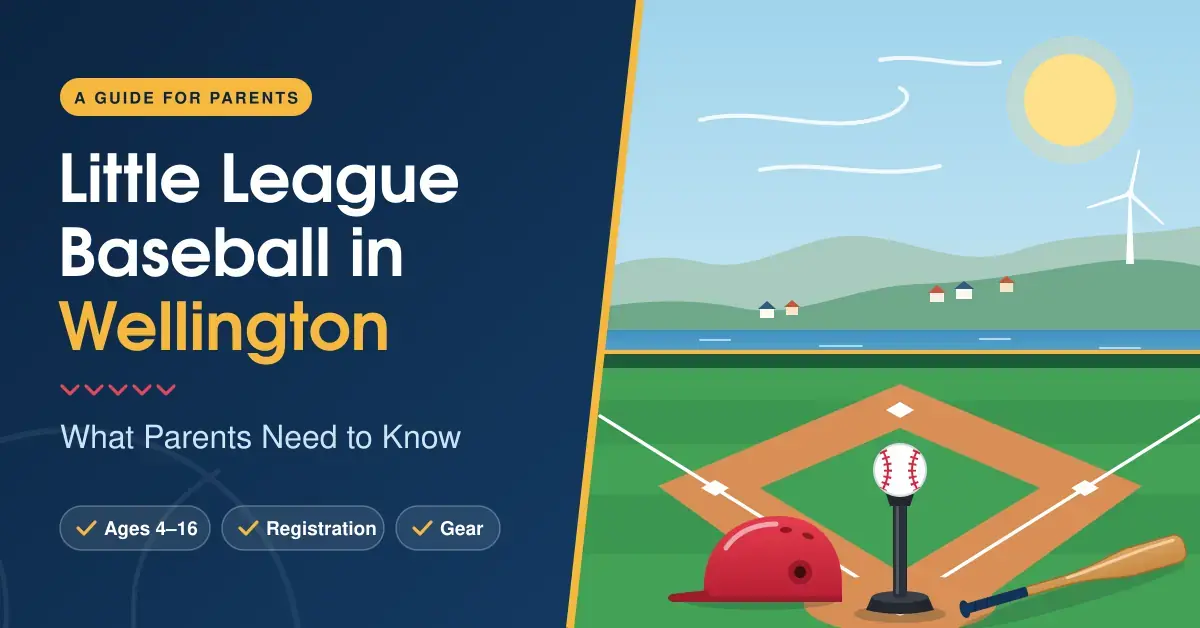
Little League gives children in the Wellington region a structured, welcoming way into baseball and softball, with grades running from four-year-olds on the tee through to teenagers playing the full game. It is run largely by community clubs and volunteers, and the emphasis is on safety, skill-building and fun rather than results. For parents, getting started means understanding how a child’s grade is decided, registering through the national online system, and organising a few pieces of personal gear. This guide walks through each step so you know what to expect before the summer season begins.
Key points
- Ages: grades run from four-year-olds in tee-ball up to 16-year-olds in senior youth baseball.
- League age: baseball uses 31 August as the cut-off date; softball uses 31 December of the previous year.
- Registration: done online through Baseball New Zealand’s GameDay Passport system; required for players, coaches and volunteers.
- Cost: a club fee (set by each club) plus a separate Baseball NZ levy; confirm current amounts at registration.
- Season: a summer sport, mostly Saturday games with weekday training and a Christmas break.
- Gear: clubs supply shared equipment; parents provide a glove, cleats or sneakers, pants and, for boys in competitive grades, a protective cup.
Understanding age grades and divisions
Little League is split into age-based grades so children play against peers at a similar stage of physical and cognitive development. At the entry level, Tee-ball introduces the basics — hitting a stationary ball off a tee, throwing, catching and running the bases — in a relaxed, non-competitive setting. As players progress they move into youth grades where they face pitching and more of the real game, and teenagers play on larger diamonds under standard baseball rules. In Wellington these grades are organised by the Wellington Baseball Association and its member clubs.
Determining your child’s league age
Little League uses a fixed “age determination date” so that placement is consistent and fair. For Little League baseball, a player’s league age is their actual age on 31 August of the current year; for Little League softball, the cut-off is 31 December of the previous year. Because your child’s league age can differ from their school-year age, it is worth checking the official age chart before you register. Grades in New Zealand generally follow this framework, commonly labelled by upper age limit — for example 12U (Majors), 14U (Juniors) and 16U (Seniors).
Grades and league ages
| Grade | Typical league age | Main focus |
|---|---|---|
| Tee-ball | Around 4–7 | Fundamentals and fun, hitting off a tee |
| Youth / Minors | Around 7–10 | Learning to track and hit a pitched ball |
| 12U Majors | Around 9–12 | Player pitching and competitive play |
| 14U Juniors | Around 12–14 | Full rules on a larger diamond |
| 16U Seniors | Around 14–16 | Advanced strategy and skill refinement |
If you are completely new to the sport, our overview of how to get your child into baseball in NZ is a good companion to this section.
The registration process for Wellington clubs
Baseball New Zealand registers players, coaches and volunteers through the GameDay Passport system, an online platform the national body adopted to manage memberships and competitions in one place. Registering is compulsory for everyone taking part, because it links each participant to the association’s insurance and administration. In practice you create a GameDay passport (a free account), confirm your child’s Little League age, select your local club and grade, then pay the fees the club sets. Registration and grade confirmation are handled by your club, so it is the best first point of contact.
Fees and what to expect after you sign up
Costs are made up of two parts: the club fee, which covers grounds, coaching, equipment, maintenance and insurance, and a separate Baseball New Zealand levy that is paid directly to the national body. Club fees rise with grade — tee-ball is the most affordable, and senior grades cost more because of longer seasons and extra gear. Exact amounts change each year and vary between clubs, so always confirm the current figures on your club’s GameDay registration page rather than relying on last season’s numbers. Many clubs are happy to arrange instalments so cost is not a barrier to playing.
- Club fee: set by each club; lowest for tee-ball and higher for senior grades.
- Baseball NZ levy: a standalone national fee paid directly to Baseball New Zealand.
- Police vetting: required for coaches and volunteers who work closely with children.
- Team placement: your club normally confirms grade and team details within a few weeks of registration.
Essential equipment parents provide
Clubs usually supply shared team gear — bats, baseballs, catcher’s equipment and often a jersey and cap — while parents provide personal items. The most important purchase is a correctly sized glove, and it helps to break it in before the season starts. Footwear rules depend on the grade: sneakers or moulded rubber cleats are fine for younger players, while metal spikes are restricted to older teenage grades. In competitive grades, boys are required to wear a protective cup, and batting helmets must be worn at the plate and on the bases.
Choosing the right glove and shoes
A glove that is too big is hard for a beginner to control, so choose one sized for your child — roughly 9–10 inches for tee-ball and around 10–12 inches for older infielders. Moulded cleats give better grip on grass than flat-soled shoes, and football (soccer) boots are a common, affordable stand-in. Our guides on how to break in a baseball glove and choosing a baseball bat for kids in NZ cover these choices in more detail.
- Glove: needed for practices and games; avoid oversized adult gloves for young children.
- Baseball pants: most clubs expect plain pants (often white) as part of the uniform.
- Cleats: moulded cleats or sneakers for juniors; football boots are a common alternative.
- Protective cup: required for boys in the competitive grades above tee-ball.
Safety rules and codes of conduct
Keeping children safe is the priority, and the rules reflect that. Batting helmets must meet recognised safety standards, metal cleats are banned in the younger grades to protect players sliding into bases, and jewellery is generally not allowed because it can snag or cause injury. Beyond physical safety, Little League asks parents and spectators to model good sportsmanship and to respect umpires and coaches. Behaviour that puts winning ahead of children’s development or enjoyment is treated as a sportsmanship issue. You can read more in our baseball safety tips for kids in Wellington.
Protecting young arms with pitch counts
To reduce the risk of overuse injuries, Little League limits how many pitches a child can throw in a day and requires set rest periods afterwards, scaled to the player’s age. Coaches track pitch counts during games, and a player who reaches the daily limit stops pitching for the rest of that day. These rules are strict and non-negotiable, so parents should expect their child to be rotated between positions.
The junior season calendar
Little League in Wellington is a summer sport. The junior season generally runs from spring into early autumn, with a break over the Christmas and New Year period, then resumes in the new year and finishes in autumn. Most junior games are played on Saturdays, with training on one or two weekday evenings. Fixtures and start dates are set season by season, so check with your club or the association’s schedule before making plans. For current fixtures, see the local Wellington baseball schedules and fixtures for 2026.
Preparing for game day
Games are played at regional parks around Wellington, and clubs rely on parents to share simple duty roles such as helping set up the field, scoring, or running the canteen. Arriving a little early, bringing water, sunblock and a warm layer for the wind, and knowing your child’s grade start time will make the day run smoothly.
Finding a local club
Junior baseball in Wellington is run through community clubs affiliated to the Wellington Baseball Association, which oversees tee-ball, youth grades (12U Majors, 14U Juniors, 16U Seniors) and open men’s baseball. Clubs are generally organised around catchment areas so children play with others from nearby suburbs and schools. The Wellington City Pirates are one long-standing club in the city, and the association can point you to the club that covers your address. For a broader look at who plays where, see our guide to Wellington baseball teams from Little League to senior teams.
Training and skill development
Most of a player’s improvement happens at training, not on game day. Clubs usually hold one or two weekday evening sessions that focus on the fundamentals — throwing, catching, fielding and hitting — with older grades adding positioning, base running and game strategy. Because clubs are volunteer-run, parents with no baseball background are welcome to help; clubs provide coaching manuals and support. If you want to know what a first session looks like, our article on what to expect at your first baseball practice is a helpful primer.
Tournaments and the pathway beyond
The season for the more competitive grades builds towards national events run under the Baseball New Zealand and Little League frameworks, including a National Little League All-Star Series and national club championships across age grades. These involve extra commitment and travel, but they give players a taste of higher-level competition. Over the longer term, the pathway leads to representative and senior baseball, and a handful of New Zealanders have gone on to play overseas in competitions such as the Australian Baseball League. For most children, though, the goal at this stage is simply to enjoy the game and keep improving.
How parents can volunteer
Junior baseball only works because parents pitch in. You do not need experience to help: clubs need assistant coaches, umpires, scorers, and committee and canteen volunteers, and they provide training for the roles that require it. Volunteering is a good way to understand the sport, meet other families and support a low-cost programme for local children.
Sources
Vanliga frågor (FAQ)
What is “league age” and how is it worked out?
League age is the age Little League uses to place a child in the correct grade. For baseball it is the child’s actual age on 31 August of the current year; for softball the cut-off is 31 December of the previous year. Check the official age chart, as this can differ from your child’s school year.
Does my child need experience to start?
No. Entry grades such as tee-ball and the younger youth divisions are designed for complete beginners, and the focus is on learning the basics and having fun. Clubs provide coaching and shared equipment to help new players settle in.
Can girls play Little League baseball?
Yes. Little League offers both baseball and softball, and many junior baseball teams in the Wellington region are mixed. Families can choose the code and grade that suits their child.
How much does it cost to play?
Costs are a club fee plus a separate Baseball New Zealand levy. The club fee is lowest for tee-ball and higher for senior grades. Amounts vary by club and change each year, so confirm the current figures on your club’s GameDay registration page.
How do I register my child?
Registration is done online through Baseball New Zealand’s GameDay Passport system. You create a free passport account, confirm your child’s league age, choose your local club and grade, and pay the fees. Your club then confirms team placement, usually within a few weeks.