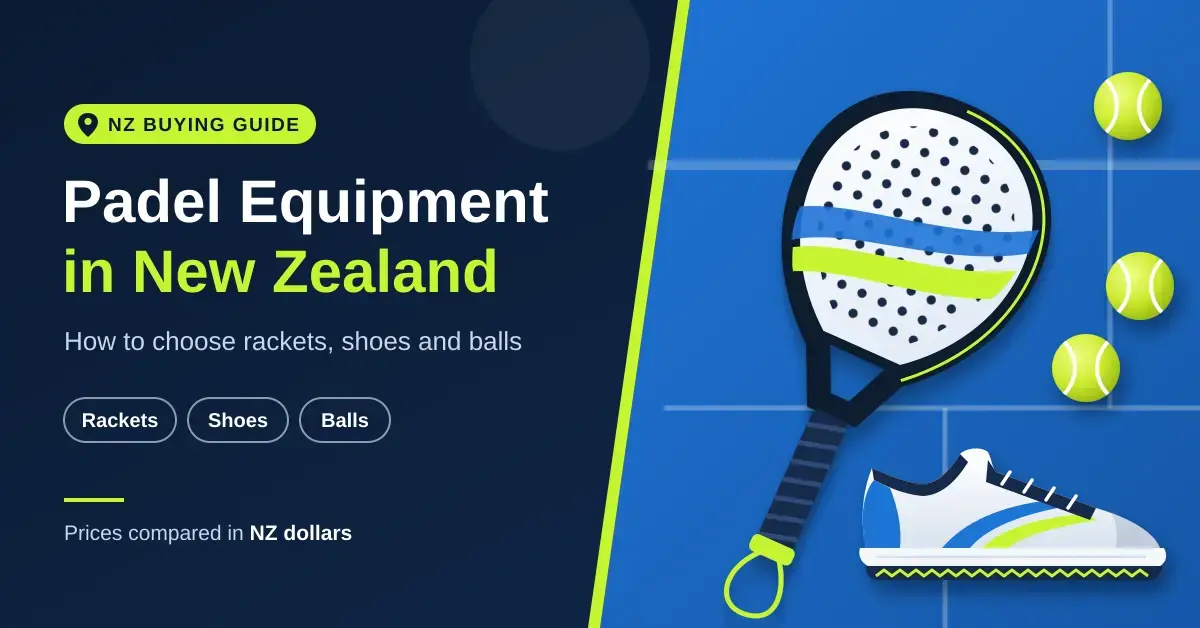
Padel is one of the fastest-growing racket sports in the world, and it has now taken root in New Zealand. If you have just booked your first court or you are ready to upgrade from a borrowed racket, working out what to buy can be confusing — local shops carry a limited range, most brands are based overseas, and prices are quoted in several currencies. This guide explains what padel equipment you actually need, how to judge quality, and how to compare local and international options sensibly, with prices in New Zealand dollars.
Key Points
- Racket shape matters most: round for control and beginners, teardrop for all-rounders, diamond for power players.
- Weight usually runs 340–390 g; lighter frames are easier on the arm, heavier ones add power and stability.
- Padel shoes have grippier, herringbone-style soles built for artificial grass and sand — tennis or running shoes are a poor substitute.
- Balls are pressurised and soften once opened; a pressuriser extends their life three to five times.
- Compare the delivered NZD price, not the sticker price, when weighing local against international retailers.
Padel in New Zealand: a quick snapshot
Padel is a doubles racket sport played on an enclosed court roughly 20 metres long and 10 metres wide, surrounded by glass and mesh walls. Points play on much like tennis, but the walls stay in play — the ball can rebound off the glass, which makes rallies longer and easier for beginners. The serve is underarm, and the racket is a solid, stringless bat rather than a strung frame.
The sport arrived in New Zealand only recently but is expanding quickly. By 2026 there are roughly 28 courts across about 10 clubs in six regions, with Auckland home to the largest share. Industry projections point to well over 200 courts by 2030 as tennis clubs convert under-used space. The national body, Padel New Zealand, oversees competition and helps new players find courts. For most Kiwis, the main obstacle is no longer finding a court — it is finding the right gear.
Why comparing prices matters for padel players in New Zealand
Because padel is new here, many sports stores stock only a handful of padel-specific products and focus mostly on tennis or general sporting goods. That can leave you choosing between a thin local range and a much wider selection overseas, where prices appear in euros, pounds or Australian dollars. Add international shipping and customs, and a “cheap” racket can end up costing more than a local one.
Comparing options with every price shown in New Zealand dollars removes that guesswork. Aggregators that pull together local and international listings — such as padel shoes NZ — let you see rackets, footwear and accessories side by side, with shipping and delivery times spelled out, before you commit. Just as a smart baseball parent compares options before choosing the right bat for a young player, a little research up front saves money and avoids buying gear that does not suit your game.
Choosing a padel racket
The racket is the most important — and most confusing — purchase. Padel rackets are solid, perforated bats with a foam core and carbon or fibreglass faces; there are no strings. Under International Padel Federation (FIP) rules a racket may be no longer than 45.5 cm, no wider than 26 cm and no thicker than 38 mm, so any legal racket sits within those limits. Within them, three things shape how a racket plays: its shape, its weight and balance, and its materials.
Shape
Shape controls the sweet spot — the area that returns the cleanest, most powerful hit.
- Round: the sweet spot sits in the centre and is the largest and most forgiving. Best for beginners and control players.
- Teardrop: the most versatile shape, with the sweet spot slightly above centre. A balance of control and power that suits improving players.
- Diamond: the sweet spot sits high, giving the most power but the smallest margin for error. Suited to strong, experienced players with good technique.
Weight and balance
Most rackets weigh between 340 and 390 grams. Lighter frames (around 350–360 g) are quicker to the ball and easier on the arm — a sensible choice for beginners, smaller players or anyone with a history of elbow trouble. Heavier frames add stability and put more mass behind a smash. Balance describes where the weight sits: a head-heavy racket favours power, while a handle-heavy one is easier to manoeuvre and control.
Materials
The faces and core determine feel and durability. Fibreglass is softer and more comfortable, absorbing shock well — ideal for newcomers. Carbon is firmer and more durable, transferring more power and holding up longer, but it can feel harsh for beginners. Many mid-range rackets mix the two to balance comfort and performance.
Padel shoes: why the sole matters
It is tempting to play in running shoes or old tennis trainers, but padel courts are surfaced with artificial grass and infill sand, and the sole is where padel and tennis shoes differ most. Padel shoes typically use a herringbone (zig-zag) or mixed ‘omni’ pattern that grips the sand-and-grass surface while still allowing controlled sliding, and they are built to support the constant lateral changes of direction, pivots and short stops the sport demands. Flat-soled tennis shoes made for hard courts offer less grip and less lateral support, which raises the risk of slipping or rolling an ankle.
Look for good lateral stability, cushioning for repeated stops, and a durable toe area, since dragging the toe on serves and lunges wears shoes quickly. Caring for gear extends its life in any sport — much as knowing how to break in a baseball glove protects a big purchase, letting damp padel shoes dry fully between sessions keeps them grippy for longer.
Balls, bags and accessories
Padel balls look like slightly smaller, lower-pressure tennis balls. They are pressurised, which means they begin losing bounce the moment the can is opened — a physical process that can only be slowed, not stopped. Frequent players get through balls faster and often buy in multi-can quantities. A ball pressuriser, a sealed tube that stores balls under pressure, can keep them at playing pressure three to five times longer, which pays for itself if you play regularly.
Beyond the essentials, a padded racket bag protects your gear and makes transport easier, while overgrips are a cheap way to keep the handle comfortable and dry — most players replace them regularly. Wristbands, caps and other apparel are optional; if you already own sporting headwear such as baseball caps, they work fine on an outdoor court, though a proper padel bag is worth the small outlay to keep your racket safe.
Where to buy padel gear in New Zealand
A handful of dedicated retailers now serve New Zealand players, alongside international stores that ship here. Local specialists carry stock ready to send domestically and often stock nets, balls and pressurisers as well as rackets and shoes. International sites usually offer a wider range but add shipping time and cost, so always compare the delivered NZD price rather than the sticker price.
As a rough guide, indicative price bands in New Zealand dollars run from around $150 for an entry-level racket to $500-plus for premium models; padel shoes typically fall between about $125 and $220; bags around $130 to $265; and balls and grips from roughly $12 to $50. Use the table below to weigh up where to shop.
Where to Buy
| Retailer | Based / ships to NZ | Range | Notes |
|---|---|---|---|
| Players Sports | New Zealand | Rackets, balls, nets | Stocks brands such as Wilson, Babolat, Tecnifibre and Head. |
| Padel Racket | New Zealand | Rackets, shoes, balls, pressurisers | Padel specialist with local shipping. |
| PDH Sports | Ships to NZ | Rackets, balls, accessories | UK racket-sport retailer with an NZ store view. |
| Padel Nuestro | Ships internationally | Full padel range | Large European specialist; check delivered NZD cost. |
Whether you are kitting out for your first session or replacing a worn racket, the same principle applies: match the gear to your level and your budget, and compare the full delivered price before you buy. A round, fibreglass racket, a pair of proper padel shoes and a few cans of balls will get most beginners onto the court comfortably — you can always upgrade once your game develops.
Sources
- Padel New Zealand — national governing body
- Kiwi Padel — Every Padel Court in New Zealand (2026)
- International Padel Federation — Rules of Padel (2026)
- Wilson — Padel Shoes vs Tennis Shoes: The Ultimate Guide
- Padel Market — Padel Balls: The Complete Buying Guide
- Scoop News — Padel has arrived in New Zealand
Frequently asked questions (FAQ)
Can I use a tennis racket to play padel?
No. A tennis racket has strings and a long handle, while a padel racket is a shorter, solid, stringless bat with a perforated face. The two are not interchangeable, and courts and clubs expect a proper padel racket.
What is the best padel racket for a beginner?
A round-shaped racket in the lighter weight range (around 350–360 g) with a softer fibreglass face is usually the most forgiving. It has the largest sweet spot and is easier on the arm while you learn.
Do I really need padel-specific shoes?
They are strongly recommended. Padel shoe soles are designed to grip the artificial-grass-and-sand surface and to support quick lateral movements. Flat court or running shoes offer less grip and raise the risk of slipping.
How long do padel balls last?
Because they are pressurised, balls start softening as soon as the can is opened. Casual players may get several sessions from a can, while regular players replace them more often. A ball pressuriser can extend their playable life several times over.
Is it cheaper to buy padel gear overseas?
Not always. International stores may list lower prices, but shipping and delivery time can erase the saving. Always compare the total delivered cost in New Zealand dollars against local retailers before deciding.