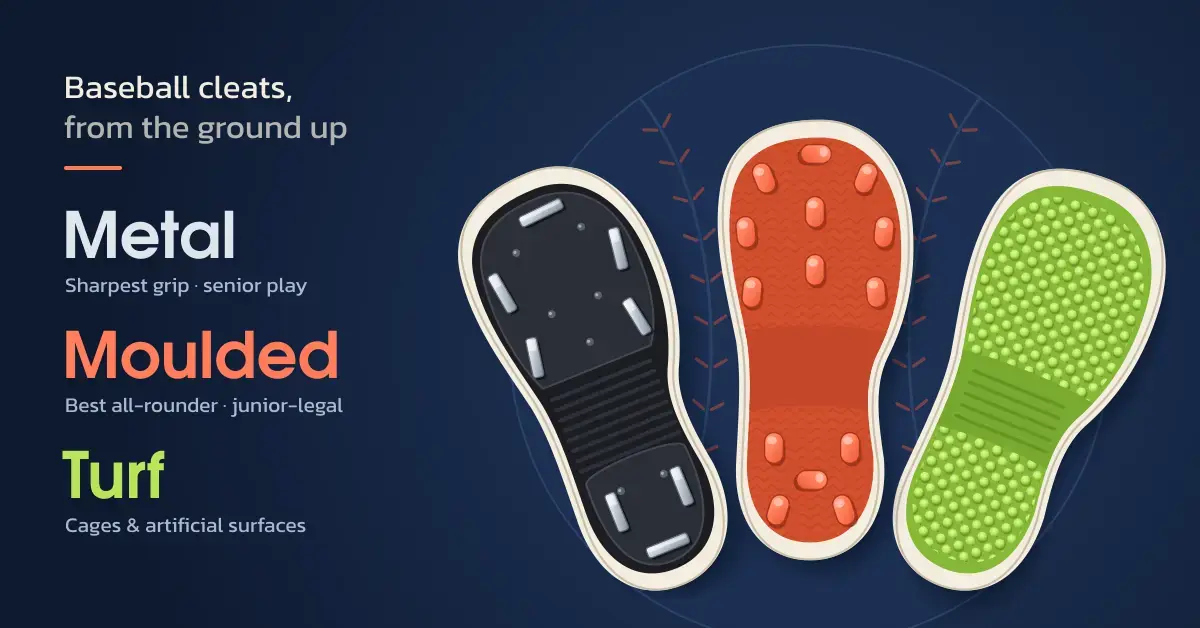
Baseball cleats are the spiked shoes that give you grip on the dirt and grass of a diamond, letting you start, stop and change direction without slipping. Choosing a pair really comes down to three things: the type of studs underneath (metal, moulded or turf), a fit that is snug without being tight, and whether your grade or league allows metal spikes. In New Zealand, where baseball and softball often share the same gear ranges, getting these basics right helps you buy once and buy well. This guide covers the main types, how to get the fit right, the rules that affect junior players, and where to find cleats locally.
Key Points
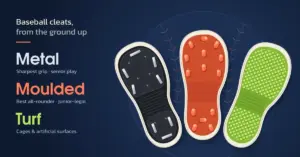
- Three stud types: metal (sharpest grip, senior and adult play), moulded/TPU (versatile, league-legal, the best all-rounder) and turf (cages and artificial surfaces).
- Cut height: low-cut for mobility, mid or high-cut for more ankle support.
- Junior rule: metal spikes are banned in the younger grades — moulded cleats are the safe, legal default for children.
- Fit: snug, with about a thumb’s width of toe room; try them on with your playing socks.
- Buying in NZ: baseball and softball cleats are often sold together — check your grade’s rules before you buy.
What are baseball cleats?
A baseball cleat is a sports shoe with studs (also called spikes) moulded or fixed to the sole. The studs bite into natural grass and loose dirt so you can drive off a base, dig in at the plate and chase down a ball without losing your footing. Most baseball cleats also have a reinforced toe, because players drag the back foot through the dirt when they pitch or swing.
They are not the same as the football (soccer) boots many New Zealanders already own. Football boots use a different stud layout built for kicking and turning, and they lack the toe reinforcement and the forward stud pattern a batter relies on when pushing out of the box. Baseball cleats can also carry a toe spike that football rules do not allow. You can get by in football boots for a casual hit, but for regular play a proper cleat is safer and more comfortable.
Types of baseball cleats
Cleats are grouped mainly by what the studs are made of. Each type suits a different surface and level of play.
Metal cleats
Metal cleats have thin steel spikes that give the sharpest grip on natural grass and dirt. They are the choice of many senior and adult players because they bite in hard and let you accelerate quickly. The trade-off is that they offer less cushioning, wear faster on hard surfaces, and are banned in most junior grades for safety reasons (more on that below).
Moulded (TPU) cleats
Moulded cleats have plastic or hard-rubber studs formed as one piece with the sole. The studs are often made from TPU (thermoplastic polyurethane), a tough, lightweight plastic. They grip well across dirt, grass and some artificial turf, sit comfortably underfoot, and are allowed in youth and adult leagues alike. For beginners and junior players, a moulded cleat is usually the best all-round starting point.
Turf shoes
Turf shoes swap long studs for lots of small rubber nubs across a flat sole. They are made for batting cages, artificial turf, indoor training and coaching rather than the mud of a live game. Many artificial turf surfaces ban studded cleats outright, so a turf shoe is often the only option there.
Some models use interchangeable studs you can screw in or swap, so one pair can switch between metal and moulded. These are handy if you play across different surfaces, but check your league’s rules before fitting metal spikes.
Low-cut, mid-cut or high-cut?
Cleats also differ in how high the collar sits around your ankle, and that changes the balance between support and freedom of movement.
- Low-cut: the collar sits below the ankle for the most freedom to move and sprint. It suits speed and agility but gives the least ankle support.
- Mid-cut: the collar sits around the ankle, balancing support and mobility — a safe middle ground for most players.
- High-cut: the collar rises above the ankle for maximum support and protection, at the cost of some mobility. Some infielders and catchers prefer it.
Metal spikes and the rules for junior players in New Zealand
If you are buying for a child or teenager, the stud type is not just about grip — it is a rules question. New Zealand clubs and associations follow Little League playing rules, which set clear limits on metal spikes by age grade.
Under Little League International’s rules, shoes with metal spikes or cleats are not permitted in the Little League (Majors) division and below, which covers the younger grades; moulded cleats are fine. Removable spikes are only allowed at those grades if no metal is exposed once they are taken out. From the Intermediate 50/70, Junior and Senior divisions upward, metal cleats are permitted.
Because grades and local by-laws can vary, always check with your club before buying metal. For most children, a moulded cleat is the simplest, league-legal and most comfortable choice. If you are still working out where your child fits, our guide to Little League in the Wellington region explains the grades and how registration works.
Baseball cleats versus softball cleats
In New Zealand, baseball and softball are closely linked and often share the same retail ranges, so you will frequently see the two cleat types side by side. They are built on the same idea, with only modest differences: softball cleats tend to have a slightly narrower, rounder toe, and some stud patterns differ. Many recreational players happily use either. The one thing to double-check is your competition’s rule on metal spikes, which applies whichever sport you play.
Getting the right fit
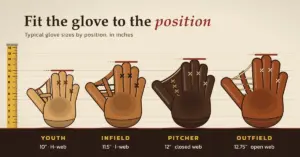
Fit matters more than brand or colour. As with choosing the right baseball glove, a cleat that suits your foot will always outperform a flashier one that does not. Keep these points in mind:
- Aim for snug but not tight, with about a thumb’s width of space between your longest toe and the end of the shoe.
- Try cleats on with the socks you actually play in, and ideally later in the day when your feet are at their largest.
- Sizing varies by brand — a size that fits in one make can run narrow or short in another, so treat “true to size” as a starting point, not a guarantee.
- Don’t count on cleats stretching to fit. Some leather uppers give a little, but most synthetics hold their shape.
- For growing children, going up half a size leaves room to grow, but not so much that the heel slips — a loose cleat causes blisters and rolled ankles.
- Break new cleats in gradually at training before wearing them for a full game.
Where to buy baseball cleats in New Zealand
Baseball cleats are a smaller niche here than rugby or football boots, but several specialist and mainstream retailers stock them, and the softball season keeps ranges on the shelves. Where you can, try cleats on in person — fit is hard to judge online. If you do buy online, check the returns policy first, and remember the variable New Zealand climate means grass fields are often soft, so dependable grip is worth paying for.
Where to Buy in New Zealand
| Retailer | What they stock | Approx. NZ price |
|---|---|---|
| Lifestyle Sports | Baseball and softball cleats, including New Balance metal and moulded models | Around $99–$189 |
| Victor New Zealand | Baseball and softball gear, including footwear | Varies |
| The Fieldhouse (Auckland) | Baseball and softball cleats and shoes (Mizuno, New Balance) | Varies |
| adidas New Zealand | Moulded and metal baseball cleats from adidas | Varies |
Prices are set by each retailer and change with stock and season, so check the current listing.
Cleats are just one part of a kit. Once your footwear is sorted, it is worth getting the rest right too — from choosing a baseball bat and a well-fitting glove to a team baseball jersey and a baseball cap for sun protection on exposed Wellington grounds.
Sources
Frequently Asked Questions
Can I wear football (soccer) boots to play baseball?
You can for a casual hit, but they are not ideal. Football boots have a different stud pattern and lack the reinforced toe a batter and pitcher rely on. A moulded baseball cleat gives better grip and protection, and some competitions specify proper baseball footwear, so check what your grade requires.
Are metal cleats allowed for junior players in New Zealand?
Generally not in the younger grades. Under the Little League rules that New Zealand clubs follow, metal spikes are banned in the Majors division and below, where moulded cleats are required. Metal is permitted from the Intermediate 50/70, Junior and Senior divisions upward. Always confirm with your club, as grades and local rules vary.
What cleats should a beginner or child start with?
A low-cut moulded (TPU) cleat is the best all-round starting point. It is league-legal across the youth grades, comfortable, grips well on most surfaces and is usually the most affordable option.
Do baseball cleats fit true to size?
Usually close to it, but sizing varies between brands and some models run narrow. Aim for a snug fit with about a thumb’s width of toe room, and try them on with your playing socks. Don’t rely on cleats stretching to fit.
Can I use softball cleats for baseball, or the other way around?
For casual and club play, usually yes — the two are built on the same design, though softball cleats tend to be a touch narrower. The main thing to check is your competition’s rule on metal spikes, which applies to both sports.